
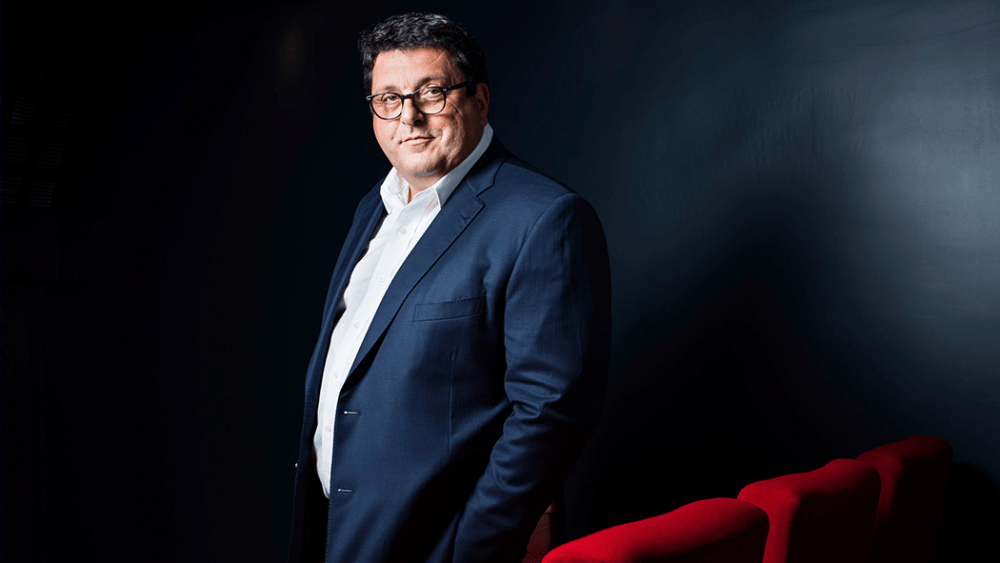
Charismatic and passionate, Laurent Habib shared his perspective, convictions, and constraints on our profession and on brands with the We Are COM team: communication today and tomorrow with voice interfaces. Former President of...Association of Communication Consulting Agencies (AACC) and still President of the agency BabelHe is undoubtedly one of the (rare) leading (independent) figures in communication in France. Get ready… it's going to shake things up!
Is communication really useful, Laurent?
Yes! The role of communication is to support the "doing," the transformative action of a "will." Communication is not there to disguise, nor to justify the lack of added value in a product. When a product is purely about communication and offers nothing to consumers, it dies: it will not see a second purchase.
Communication is useful and important in a society where everything is constantly changing. It serves to build strategies, create new identities, and bring about transformations. But I must admit that it also worries me when it is merely words coupled with inaction on reality. This seems to me to be a deviation from our society.
What is corporate communication to you?
It is a system of meaning built around a legal entity, the company. This extends into its multiple relationships with its stakeholders, including the commercial relationship. To separate the company from its relationship with its customers is, in my opinion, nonsensical.
In the 70s and 80s, the emergence of " companies brand This has highlighted a new facet of brands, relating to the company itself and its overall system of relationships with its stakeholders. Thus, in addition to communication presenting what the company sells (commercial communication), communication has been added on how the company produces its goods and services.
I have long fought against the term "corporate communication" for a very simple reason: To remain within the realm of corporate communication is to forgo what is relevant for an advertiser in their communication strategy.In reality, there is a continuum between commercial communication and corporate communication. To slice this continuum by saying " Oh no, that's no longer my area of expertise. "has no meaning in reality."
So what would be the scope of expression of the " companies brand "?
Employer branding, internal communication, CSR, investor relations… All these areas of expression contribute to building a company's overall image and attractiveness. They are differentiating factors for consumers, and therefore factors influencing customer preference.
McDonald's perfectly illustrates the interfaces that exist between product communication and corporate branding. The CSR dimension – from supporting French farmers to diversifying the menu (salads, fruit, etc.) – plays a very important role in point-of-sale communication. This message addresses both image and revenue concerns. It's truly comprehensive marketing.
There is always a connection between a company—its history, its expertise, its people—and its products. This balance is constantly evolving because the production of goods and services is gradually becoming more and more homogenized—even low value-added. Everyone is capable of producing the same thing! In reality, it is the way in which a company produces its goods and services that becomes the deciding factor for the consumer.
The physical object is therefore no longer the core of value in our economy, while conversely the brand represents a growing share. Overall, intangible elements are becoming increasingly important: aspects related to the "soul of the company" are key in shaping consumer choice.. The " company's brand " is now at the heart of communication issues.
Are we at the brand's peak or at the beginning of its decline?
I think that brands reached their peak with the internationalization of major trade: containers across the world, Hollywood cinema, the Olympic Games, etc. From the 1960s onwards, brands established themselves as transnational cultural references: Coca-Cola, Toyota, Intel, Disney, Colgate, etc.
And since the 2010s, brands—powered by digital technology—have entered people's lives, becoming everyday interlocutors and content producers. Look at Red Bull: is it just a drink? No, the brand extends to events, a magazine, and more. The brand is now a media outlet and possesses real mobilization capabilities. Meanwhile, the world of institutions and politics is no longer able to mobilize people.
Despite this rosy picture, I fear a decline in branding due to the GAFA (Google, Apple, Facebook, Amazon). A new relationship with the world, with people, and with objects is emerging. It will transform the relationship between brands and their audiences. The brand will no longer be a prerequisite for the act of purchasing in areas that will be identified by the consumer themselves. Every individual determines a proportion of their consumption devoted to brands or not. Do you know the brand of your paper towels? No. The brand of your toilet paper? Yes (the answer is statistically significant!). Yet these are two relatively similar consumer goods.
We are in the process of "dualizing" our consumption, with on one side a world without brands (or store brands) and on the other side a world with brands and major brandsThe distinction is made based on the level of consumer involvement and the experience that the brand provides.
For a DVD player, the level is low because it only provides the functionality. For a speaker system, the level is high because it delivers an experience. When I need to change the batteries in my remote control, I don't care about the brand: I want batteries to make my TV work. By listing its own batteries in its catalog, Amazon has captured 30% of the global battery market, and brands like Duracell and Energizer risk disappearing.
The strategy of distributors is to be an audience hub between consumers and major brands, and to compete with the latter through their own private label products, which generate more revenue.
Today, the proportion of consumption is 70% for major brands and 30% for store brands. But that won't last!
Could this balance change with new voice interfaces, a subject that is dear to your heart?
Yes, because tomorrow voice interfaces will dominate our relationship with the world: they will be the intermediaries for 50% of interactions in 2020. Now let's think about how consumers will express their requests to a voice interface. If you need to go to Lyon, you will say, " I want a train ticket to Lyon » without specifying SNCF or Oui.SNCF You will naturally be in the functional realm.
I therefore fear that voice interfaces will accentuate the duality between the brandless world and the branded world, and that ultimately consumption will be dominated by functionality rather than experience.Thus, a new value relationship will be established between the different actors in the economy, between producers and distributors.
Facebook and Google have taken a major share of the digital advertising market and tomorrow they will absorb – via their voice interfaces – more and more advertising investments. This new era of referencing will lead to a redistribution of value that will shift from producers to intermediaries/distributors.These situations of dependency already exist: mobile applications with app stores, music with iTunes, online press with Google, series with Netflix, etc. Distributors will become the communicators of brands.
So what should brands do to avoid this dependence?
Brands can no longer remain structurally dependent on intermediaries who, by their very nature, have their own interests. It's crucial to understand that the power of these players is immense. This is not an acceleration or a change of scale; it is a profound rupture in our society.Brands must realize that the nature, density, intensity, and periodicity of their relationship with their audiences is a matter of life or death.
We are no longer in the battle for preference, but in the battle for existence. If a brand does not build its uniqueness, it risks being abandoned by its customers, ignored by its target audiences, and becoming a mere function before dying, weakened by the increasing cost of its dependence on new intermediary distributors.
And what advice would you give to communications professionals?
Communication is a wonderful profession, a daily struggle to better connect tools with the brand, and the brand with the company's strategy. It requires ambition for the profession, and never abandoning that ambition. Don't become mere cogs in the machine, tied to a single communication tool—the annual report, the customer newsletter, the internal magazine, and so on. The danger for communicators is being quickly consumed by the frenzy of production and losing sight of the meaning of their work. Return to the fundamentals: the brand. It is your sole focus.
It must be able to fully play its role within and for the company, because it generates value. This concern isn't just the responsibility of the Head of Communications. It's the mission of every communications professional within their area of expertise, whom I encourage to strive for breaking down silos between disciplines: corporate communications must focus on customer relationships. It's an exciting challenge!
In my opinion, this job is one of the most extraordinary in the company because it has real leverage over reality.
3 things to know about Laurent Habib:
- – Where does it come from? He spent 22 years at Havas, before creating Babel in 2012.
- – Why “Babel”? According to the Bible, the people of Babylon began building a tower to reach Paradise directly. But God disapproved of this project. To punish them, he gave them tongues. They could no longer speak to each other, understand each other, and therefore could not continue their project. Babel collapsed. The myth of Babel is thus the myth of communication: if it is merely idle chatter ("babble"), it leads nowhere; if it is a true language that allows for exchange ("babel"), it leads to heaven. That's all!
- – What did he write? Transformative Communicationand the The power of the immaterialThese are his two books published by Presses Universitaires de France. Remarkable for his convictions.