

Jeff Bezos, founder of Amazon, states: Your brand is what people say about it when you're not in the room. » 🧐 And precisely, what is it?public opinion What do brands think about? Should they be universal or confidential? What are the new expectations of consumers? 👀 These are just some of the questions the team We Are COM shared with the Viavoice Institute, which conducted an exclusive study of 1.000 French people*. The results are here! 👇
During a workshop of the Club We Are COM, Arnaud Zegierman, a fascinating sociologist and associate director of the Viavoice institute, deciphered with us the results of this survey on the underlying factors of brand attractiveness🤓 Let's get started with an analysis of consumer expectations in France in 15 quick questions!

#1 What is the impact of company size on attractiveness?
In general, this study shows that the French place more trust in small businesses (52%) than in large companies (21%). In other words, a small brand seems a priori to attract consumer preference.
However, we observe that the population remains divided on this issue. Large companies remain highly attractive because they are synonymous with reliability and trust. While the trend is shifting more towards smaller brands, this is largely due to younger generations (27%) and managers (39%), who are more sensitive to the issue of local impact.
The main factors in this segmentation relate to generations and socio-professional categories (CSP). Certainly, major brands reassure consumers globally, but they are increasingly expected to perform at the local level as well. The "glocal" trend is now the primary challenge for major global brands.
The “glocal” trend is now the primary challenge for major global brands.
#2 What type of brand do the French prefer when making a purchase?
When buying a product or service, the French prefer to invest in a well-known brand (22%) over a lesser-known brand (5%). But be aware: this varies depending on the type of product. Note that 30% of consumers would be more attracted to a brand with which they identify, for example, by sharing a common value system..
#3 What are the criteria for choosing a well-known brand?
First, a well-known brand provides reassurance. It acts as a label and conveys a certain level of confidence regarding the quality of its products and services (48%), the availability of those products and services (27%), and after-sales support (30%). Price is also a key factor (27%), with consumers finding it more affordable when it comes to well-known, established brands.
In other words, the well-known brand has proven itself in the eyes of consumers, who will have greater confidence in the service offered. It is therefore utilitarianism and pragmatism that motivate their choices.
Therefore, utilitarianism and pragmatism motivate consumer choices.
#4 What are the criteria for choosing a lesser-known brand?
Identification is the major advantage of lesser-known brands (31%), which are more committed to ethical and ecological issues. The French claim to define themselves by what they buy: they are therefore primarily looking for brands that align with their values.
Note that several selection criteria lead consumers to choose lesser-known brands: quality (30%) and expertise (28%). Indeed, The more niche brands seem to convey an image of specialistism. Furthermore, the differentiating aspect is taken into account. Consumers appreciate these brands for their unique characteristics (26%).
The French claim to define themselves by what they buy: they are therefore primarily looking for brands that align with their values.
#5 What are the criteria for a brand's attractiveness?
It is once again the utilitarian dimension that seems to motivate consumers, since those surveyed believe that the essential criteria are reliability and trust (43%), the product or service itself (41%), know-how (35%) and the ability to innovate (19%). Once again, the argument of evidence prevails.
It is surprising to observe that a brand's image, its history and its morals are relegated to the background. Is the myth of attractiveness produced by brand image outdated? Not if we believe that brand image is ultimately just the result of the accumulation of several brand expressions. Reliability is a consequence of expertise, and attractiveness is a consequence of reliability.
#6 What are the expectations of French people with regard to brands?
Above all, the French expect ethical practices from brands. They advocate a very pragmatic vision of communication: that of transparency and trust. According to our study, consumers are extremely sensitive to value for money (60%), reliability (53%), and the assurance of making the right choice (37%). Along the same lines, it's worth noting that 27% of respondents primarily expect a brand to not "lie."
#7 Do the French prefer well-known or lesser-known brands… depending on the purchase category?
The answers to this question should be considered in light of the hierarchy of needs theory. Maslow's pyramid. Indeed, well-known brands are preferred in highly technical sectors, which require real reliability: banking and insurance (54%), technology (53%), housing (51%) and health (45%).
While lesser-known brands seem to be preferred for purchases related to a " lifestyle ", those which allow each person to express their identity: fashion (30%), leisure and culture (28%) and decoration (27%).
It is interesting to note that regarding the products Regarding food and alcoholic beverages, opinions are relatively divided. Consumers expect greater vigilance from these sectors, along with the promise of a new way of consuming. It is this phenomenon that has allowed the emergence of small brands, carrying new values, on the shelves of large retailers.
#8 What do the French like most about their favorite brand?
Unsurprisingly, the French prefer a brand for its products (36%) and its prices (25%). Utilitarianism aside, sincerity (25%), identification (25%), and values (19%) are paramount. Next come brands that appeal to everyone (15%), brands that unite a large number of users (14%), and those that follow societal trends (13%).
#9 What are the general perceptions of brands?
72% of respondents expect a brand to understand its customers, while 70% believe a brand should understand society as a whole. Generally speaking, The French seem quite ambivalent on this issue. They want to see brands that are big enough to generate trust and small enough to stand out. Is this one of the ingredients in the recipe for success of luxury brands, known to all but accessible only to a few?
The main risk for a mass-market brand would be becoming too bland by trying too hard to please (62%). What conclusions can be drawn from this? communication must be more impactful than ever and provide evidence. communities want to find themselves reflected in a brand's message.
Some bonus figures:
- 69% believe that a brand should bring people together around the world around a single product/service.
- 68% believe that a brand should be a guarantee of reliability for a product/service.
- 60% believe that a brand must first and foremost embody values.
- 58% believe that a brand allows one to assert their identity.
- 54% believe that a brand allows one to stand out.
- 53% believe that mass-market brands can only offer standardized products/services.
Communication must be more impactful and provide evidence than ever before. Communities want to see themselves reflected in a brand's message.
#10 What if brands were to… disappear?
The majority of respondents stated that they would miss out on the disappearance of brands, finding less enjoyment in their shopping habits (41%). However, many French people believe this would be a good thing, as they dislike having to choose between several identical products (37%).
The proportion of consumers who feel they do not regret the disappearance of brands is ambiguous. But shouldn't this figure be correlated with previous results? Indeed, it should be compared with Maslow's hierarchy of needs mentioned earlier. The motivations for high-stakes purchases are much less personal than for spontaneous purchases.
#11 What is the ideal brand today versus the ideal brand of tomorrow?
The ideal brand today seems to be a global one, according to 49% of respondents, compared to 32% for more niche brands. However, this trend could weaken, as the figures are projected to decrease from 45% to 37% in the coming years.
Indeed, Confidential brands are gradually gaining ground, being particularly popular with younger generations. This reinforces the idea that even if global brands will always have a role to play, they risk being gradually eroded by their rivals. notoriety growing. The health crisis has gone in this direction, fundamentally increasing local sovereignty.
Even though global brands will always have a role to play, they risk being gradually eroded by their rivals with increasing renown.
#12 Why will global brands be so successful?
When we ask French people who say they like global brands, we find that they are appreciated for their accessibilityTheir ability to unite, their competitive prices and the confidence that they arouse.
- For 37%: they are very widely accessible globally, known by a very large number of people and therefore capable of significant investments in marketing.
- For 19%: they have a unifying power, correspond to expectations and meet the needs of the greatest number.
- For 12%: they are competitive and therefore cheaper.
- For 12%: they are a guarantee of trust, quality and reliability.
#13 Why will lesser-known brands be so successful?
According to those who prefer more niche brands, their success is based on the commitments CSR, the consumer segmentation, the societal anchoring and the know-how.
- For 29%: they allow us to consume locally, responsibly and ethically. They promote local and proximity with an ecological focus.
- For 19%: they offer products that are more tailored to customer needs and stand out through greater diversification, personalization, and innovation.
- For 17%: they respond to the society of tomorrow and its values and constitute the remedy to the weariness of the current system, globalization and conformism.
- For 12%: they offer reliable and quality products, emphasizing expertise and generating trust.
#14 What are the brand's reassuring elements?
Once again, the results to this question are relatively contradictory. Price seems to remain the primary concern for the French. (43%), however, the local (36%) and artisanal (26%) production methods remain strong elements of reassurance.
Unsurprisingly, honest and transparent communication (30%), as well as a commitment to the environment (28%), are values favored by consumers.
#15 What is the expected role of brands in society?
Above all, it emerges that the French expect brands to invest and commit themselves, particularly in respect of the environment (44%), fairness (40%), accessibility (33%), equality (28%), societal impact (22%) and local impact (18%). A brand can no longer simply follow societal changes; it must anticipate them and participate in them.
Let’s add that The French absolutely do not expect brands to position on political or religious topics.
Above all, it emerges that society expects brands to invest and commit themselves, particularly in respect of the environment, fairness, accessibility, equality, societal impact and local impact.
BONUS Can the brand image be perceived as sincere?
The brand image is only perceived as sincere by one in two French people. 45% of consumers believe that a brand is not truly aligned with what it really isA figure that aligns with our previous study conducted with Viavoice around the concept of sincerity!
(I.e. We recap
There is no such thing as an absolute brand. There isn't one brand that resonates with us, but rather brands that appeal to us. 😍 Well-known brands appeal to the French because of their reputation, which is seen as a sign of responsibility, while lesser-known brands are more appealing for their expertise and commitment.
Furthermore, the French want brands to demonstrate... responsibility and ethics. ♻️ They must understand their clientele while addressing society as a whole.
And then what? 🔮 It would seem that niche brands will be the most popular in the coming years, a trend already initiated by younger people and higher socioeconomic groups.
And finally, a little caricature of our speakers
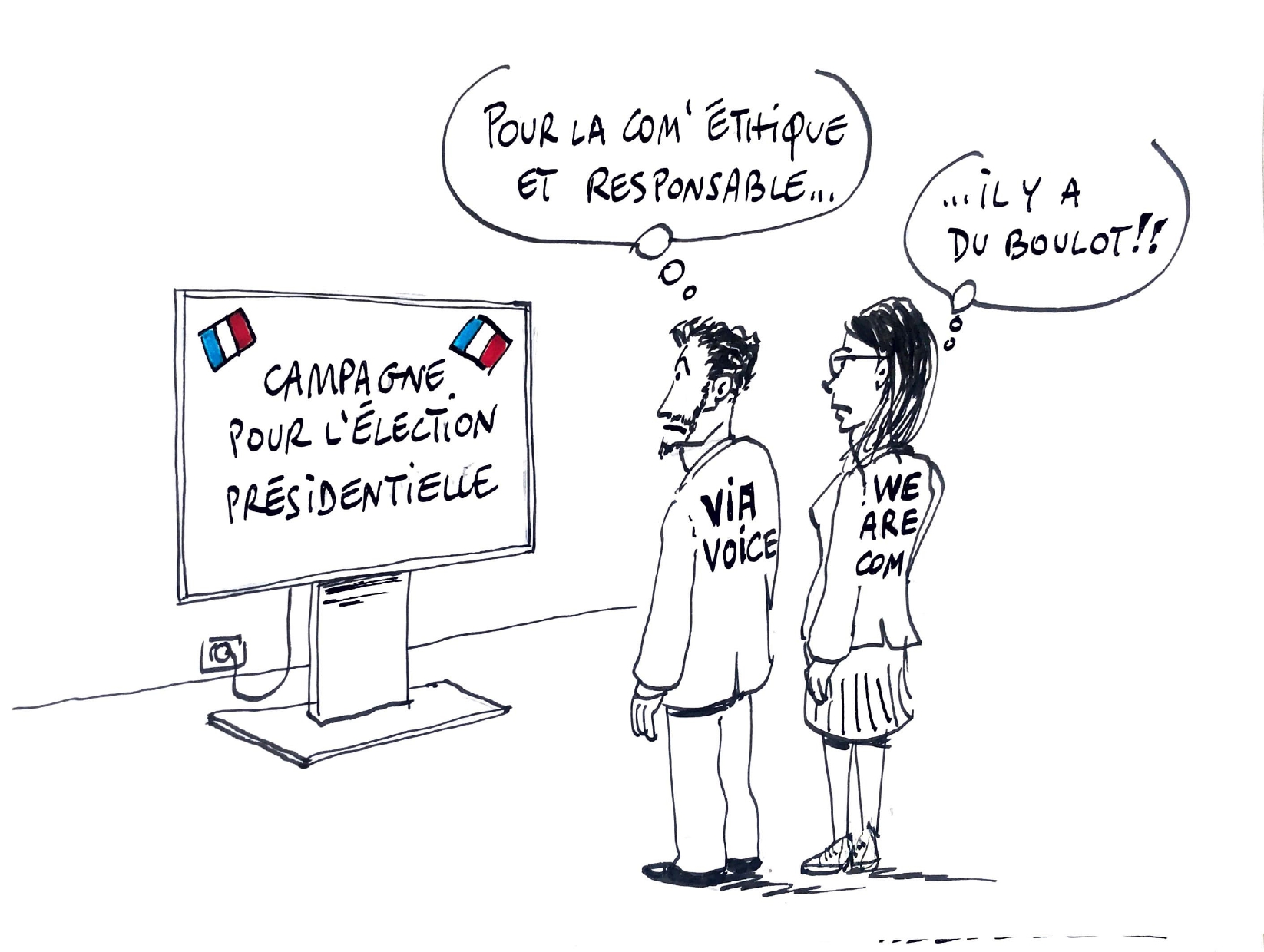


🎥 See the replay of the conference and tdownload the presentation slides

* Study conducted by the Viavoice Institute for the We Are COM Club online from February 25 to 28, 2022, with a sample of 1000 people representative of the French population aged 18 and over, residing in metropolitan France.
Representativeness is ensured by the quota method applied to the following criteria: gender, age, profession, region and size of urban area.