
Communication is the art of adaptation. As communicators know, it's by constantly adapting to society that their messages manage to make sense and resonate with the audience. 🤓 Indeed, as the semiotics expert so aptly puts it, Élodie Laye Mielczareck, who are " Words reflect the ills of our society ».

Also, What words defined 2022 and what will be the essential expressions of 2023? 🚀 The Club We Are COM went to take a real lesson in semiotics from this language specialist, author of Antibullshit, Post-truth, nudge, storytelling: when words lose their meaning (And how to fix it).
Hello Elodie, first of all, why is the study of words essential for communication?
Words are tools for communicators. They are shaping a collective semantic pool. More than anything else, they embody society: its fears, its needs, its desires, its projections, its monsters and more broadly all of its collective failings.
How are these semantic basins formed? How have recent years impacted them? What will the consequences be in 2023? These are all essential questions for you, language professionals.
First, let's remember that there are several types of words, depending on their usage. Here are 5 types, which I think are important to detail before getting to the heart of the matter.
- The word "star" It experienced a significant peak in usage in 2022, without necessarily having been widely used beforehand. Example: "sobriety".
- The word "beat" It has been used repeatedly in recent years and will continue to experience peaks in usage at certain times. Example: "eco-anxiety".
- The word "rocket" Its use is increasing; it's a word that's gaining popularity. Example: "trans identity".
- The word "zombie" or word Has Been, is a former "star" word, having enjoyed great success in previous years but recently having been emptied of its meaning. Example: "collapsology".
- The word "Voldemort" It must absolutely no longer be uttered. This word, banished by social pressure, must most often be replaced by new terminology. For example, "poor" becomes "person in a situation of involuntary sobriety."
What were the words that occupied our mouths and minds in 2022?
Certain themes defined 2022. But before exploring them, let's take a brief look at Covid-related vocabulary. Even though "covidé" (a term for someone infected with Covid) received a definition in the 2023 edition of the Robert dictionary, words related to the pandemic have faded from the forefront recently. The somewhat medieval feel of terms like "curfew" or "quarantine" is gradually disappearing from our vocabulary.
#1 – The words of the digital age
In terms of digital technology, Many buzzwords made headlines in 2022, including the terms "NFT" and "metaverse". The case of "metaverse" is very interesting because it is linguistically ambivalent, both in its pronunciation and its spelling. With or without an accent? Singular or plural? Should it be pronounced in the English or French way, "multivers"?
In reality, the use of this term is not truly fixed, just like its concept which is not yet well understood by everyone. In other words, a concept that is difficult to represent in people's minds cannot have a fixed representation in language.
In the universe of digitalwe also observe the presence of zombie terms, which are losing popularity, such as "avatar" or "virtual reality"Regarding rocket-like words, it should be noted that “Transhumanism” follows a fairly stable progression, while “progress” is used less over the years.
Finally, with regard to Social Media, without surprise, It is the Twitter platform and its recent acquisition by Elon Musk that has generated the most discussion. The term "instagrammer", meanwhile, will not be included in the dictionary until 2023.
#2 – The words of economics
In economics, concerns appear to be both individual and collective. Therefore, The star word in the world of economics is undoubtedly "sobriety". This term, featured on numerous newspaper front pages in 2022, perfectly reflects the president's rhetoric and his favorite topic: the end of abundance. As a consequence, "poor" has become a word associated with Voldemort. Similarly, the term "austerity," omnipresent during the last presidential campaign, is now also giving way to the star word "sobriety."
However, be careful, Some already prefer to replace the latter with the more attractive term "frugality"., another star component of last year. Indeed, sobriety can take on a more negative aspect, since historically and etymologically speaking, it connotes lack.
These new meanings tend to render obsolete former star terms, such as "deconsumption" or "degrowth". Nevertheless, in order to circumvent the problem, some intellectuals propose neologisms like the "a-growth" coined by the philosopher, Gaspard Koening. There are a multitude of games and constructions around the lexicon of growth, always to support this question of the end of abundance.
Finally Yes "inflation" is a star wordIts corollary, "purchasing power," is more of a buzzword, a recurring theme in recent years. I would say that it's through a psychologization of "perceived" purchasing power that this term is now tending to become indecent. No one wants to imagine their wallet empty anymore, whereas just a few years ago that was less of a reflection of our realities.
#3 – The words of transition and transformation
Generally, The vocabulary of the pandemic is giving way to that of the apocalypse. The term "apocalypse," a dominant buzzword in 2019, has resurfaced following natural disasters (fires and blazes) and international instability. Certain recurring keywords, consistently present online, are reappearing en masse: "conflict," "war," "weaponry," "revolt," "revolution," and "human rights."
Ecology remains at the heart of concerns, however the term "ecoterrorism" is preferred. This neologism appeared on the covers of numerous magazines in 2022. Similarly, the buzzwords "eco-anxiety" and "solastalgia" continue their upward trajectory. For your information, solastalgia is a nostalgia not directed toward the past, but toward the future. These new terms are eclipsing some of the buzzwords of previous years: "collapse" (2017), "survivalism" (2018), and "collapsology" (2020).
Finally The use of the words "change" and "impact", which peaked in 2019 and 2020, is not declining. Their kindred spirits "transition" and "transformation" are also following suit, although it remains preferable to speak of "transition" rather than "transformation." Finally, the term "climate" has been revived, certainly thanks to the recent COP27.
#4 – The words of the social and societal
Since 2019 and the Pacte Law, The phrase "mission-driven company" literally floods the lexical pool of 2022. Therefore, the expression "greening of image", translation of the greenwashing, makes its appearance in the 2023 edition of Robert.
The controversial terms "woke," "wokism," "intersectionality," "inclusive writing," and, more generally, the use of suffixes ending in "-iel," belong more to the vocabulary of 2021. While 2022 saw an explosion in the use of the phrase "gender transition" and the emergence of new constructions around the lexeme "de-", symbolizing a return to origins, with "de-transition" or even "de-transitioner". The terms "trans identity" and "degender," however, continue to be used repeatedly.
For its part, "Inclusion" has seen strong and steady growth for several years and positions itself as a key word in societal issues.
#5 – The words of relationship difficulties
Please excuse my language in advance. 🙂 It is the lexical field of "stupidity" that has entered our daily lives since 2018. The titles editorials They're redoubling their creativity when it comes to stupidity, a phenomenon completely unimaginable just a decade ago. It's worth noting that the topic of "idiocy" sells, especially in a back-to-office atmosphere after a series of lockdowns. Is it a meltdown or a public lynching? The question of how to deal with idiots is truly at the heart of everyone's concerns.
All of this clearly reflects certain tensions. Have we become more intolerant or more hypersensitive? In any case, the term "hypersensitive" is a buzzword, omnipresent for several years now. In the same vein, we also find many recipes for "Stress management", a consequence of a somewhat gloomy, or even aggressive, interpersonal atmosphere.
In 2022, The concepts of "radicalism" and "radicality" have experienced peaks in usage. However, they were more focused on political speeches than on phenomena of religious radicalization.
And finally, to conclude this section on a note of optimism, The word "democracy" is making a big comeback. Its occurrence has become increasingly frequent over the past few months.
#6 – Words from the “good times”
Finally Having a good time was a key topic in 2022, particularly with the concept of "chilling". The Robert dictionary has even included the verb "chiller" in its latest edition, demonstrating the importance of these notions of well-being, introspection, and "cocooning." Ikea was the first brand to use this star word in its... slogan “Chill at home”, in 2020. Since then, this concept has continued to generate buzz. Today, "Netflix and Chill" has truly become a way of life.
But what about the constraints? Still with this focus on well-being, The work seems to be plagued by the crystallization of numerous tensions. Also, the phrase "silent resignation", or quiet quitting became a flagship in 2022 and the term " laziness " seems to be making a comeback. In 2023, we will face many questions surrounding the concept of work, particularly regarding the boundaries between professional and personal life.
Bonus: a 2022 antonomasia, for the road
Have you seen the antonomasia "macroner," in which the name of the President of the Republic becomes a verb in everyday language? This expression, which originated in the Ukrainian trenches, supposedly means "to be very worried about a situation, but to do nothing." So, when will the verb "macroner" be included in official dictionaries? 🙂
What are the key concepts for 2023?
Before making predictions for 2023, let's remember that concepts are less variable than words. In other words, Signifiers can evolve in their materiality, while signifieds remain. What are the major concepts of 2023? How should we interpret them?
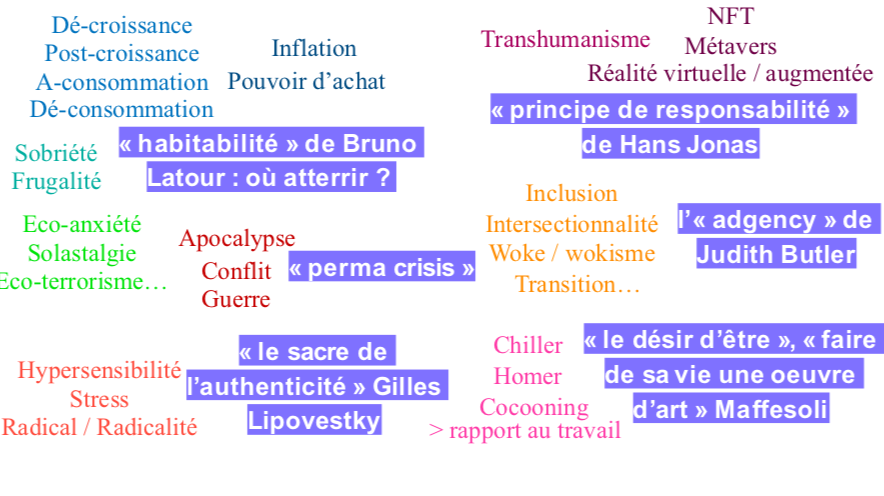
Concept #1 – Habitability
The philosopher Bruno Latour, who originated the concept of habitability, poses this fundamental collective question, "Where to land?" This postmodern thinker reflects on the world in which we live, these microcosms whose ecosystems we manage to disrupt together. The existential issues of collective construction will remain fundamental topics.
Concept #2 – The perma crisis
Let's return to the terms "eco-anxiety," "solastalgia" (nostalgia for the future), or even "eco-terrorism," which, in addition to fueling discussions about habitability, also fuel the apocalyptic themesThe term "perma crisis" is a neologism first used by a British journalist. It highlights the fact that crises are no longer isolated incidents, but permanent. In other words, we are living in a gigantic crisis.
Concept #3 – The coronation of authenticity
Regarding interrelational dynamics and the radical nature of stances, let's return to Gilles Lipovetsky's concept. This postmodern thinker seeks to determine what is authentic and what is not, an extremely relevant question today. Indeed, Today, we are no longer in search of truth in information, but of authenticity and embodiment. Also, terms related to "hypersensitivity", "stress" or even "radicalism" of opinions, will continue to feed the lexical pools of 2023.
Concept #4 – The desire to be
Still in this reflection on postmodernity, sociologist Michel Maffesoli contrasts two visions. Previously, individuals desired to "succeed in life" through work. Now, they seem more inclined to "make their life a work of art" by indulging themselves. This questioning about well-being at home and the relationship to work will also continue to fuel the debates.
Concept #5 – The agency
Once again, Judith Butler's concept of agency reflects a very postmodern view of things. It is the power to act and the power to engage with the world, belonging to each individual. What is our power to act? And what power to act are we able to give to others? These questions become fundamental, even more so for communicators.
Concept #6 – The Principle of Responsibility
Finally, Hans Jonas had spoken a lot about questions of responsibility and our obligation to issue ethical principles to preserve the future of the human conditionIn my opinion, these questions will preoccupy us for the next few years.
Shall we recap?
For many years, it was accepted that saying nothing meant wanting to remain neutral. This is a very modern view of things. Now, you have to want to be yourself and speak out radically. It has become essential to embody yourself, to tell your story. To what extent will companies, brands and communicators be able to remain neutral in this changing society?
Beyond the rise of purpose-driven companies, which flourished in 2022, it seems essential to me that a brand at least enshrine its purpose in its legal statutes. More than ever, a company must respect governance requirements and assert its identity as a legal entity. No one will be able to escape postmodernity anymore.
🎥 Watch the full replay and download the presentation support