
A career is a living thing. It evolves according to our desires, our needs, our skills development… Yet, caught up in the heat of the moment, we sometimes wrongly put it aside! So, how do you take control of your career? How do you make the best professional choices in the field of communication? Le Club We Are COM has decided to offer you an expert lesson on the subject.

And indeed, the inspiring teacher of this workshop is a true human resources expert. Anne Moreau, Head of HR Development within the La Poste Group, provides daily support to numerous teams, particularly in communication, in the management of their professional projects.
Thank you for speaking with us at the We Are COM Club, Anne! What do you need to know before taking charge of your communications career?
Let's start with a definition. What is a career, in the literal sense of the term? A career is developing a sustainable and evolving professional activity in a function.
So, what exactly does "making a career" mean? It simply means "progressing in one's career." This progression can be horizontal, when one changes roles within the same field of expertise, or vertical, when one receives a promotion. And let's not forget career change. Anything is possible, you are the architects of your own career!
Corn (Mais) Your career is also everyone's business, especially that of your manager and your company. whose duty is to inform, train and support each employee in their professional project.
In terms of figures, more than half of the workforce would be looking for a new job in 2023 (55%). Their main motivations are salaries and financial and social benefitsTherefore, my advice would be to look at what you already have before leaving your current position.
Next comes the question of the balance between personal and professional life. Increasingly, employees are looking for flexibility and adaptability, particularly with regard to working hours and teleworking.
The type of contract also influences workers, especially younger generations. These companies are increasingly reluctant to sign permanent contracts. The trial period no longer seems sufficient for them. They prefer the freedom offered by freelance or time-bound assignments to the stability of a long-term contract.
Finally, the concept of experience can impact career progression. What do recruiters think of your years of experience in the same position?
- * 3 years old: In general, your skills have been proven. You have had time to adapt to your tasks, you have reached a level of expertise that allows you to be more creative, and you are recognized by your peers.
- * 5 years old: You've entered your comfort zone. The tasks hold no secrets for you. This is the average length of experience required to change jobs or companies if your current one doesn't offer opportunities for advancement.
- * 7 years old: Your comfort zone can be a risk. If you haven't varied your tasks and collaborated with different teams, if you haven't continued to train yourself in parallel – with We Are COM for example 🙂 – it can become more complicated to position oneself for a new job.
So, even in a comfort zone, Always remain curious and constantly look at what is being done elsewhere.
How does one build a career in communications? What are the steps to follow?
#1 – I look in the rearview mirror
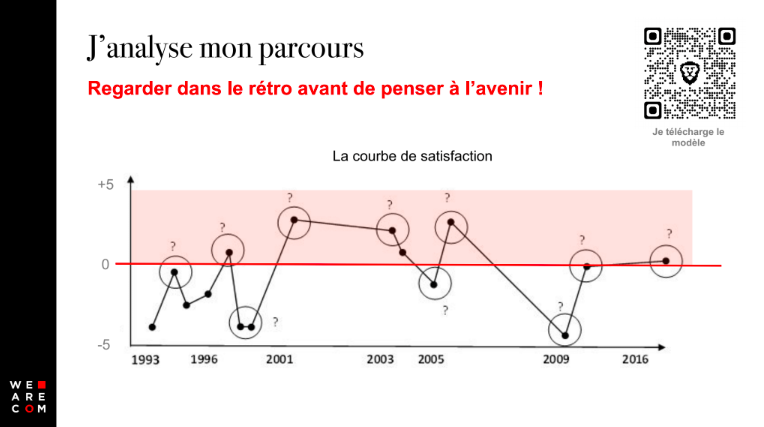
Before thinking about the future, it's essential to take stock of the past by conducting a self-assessment. Ask yourself what you want to do and what you no longer want to do. List your skills, whether technical or behavioral. Soft kills are truly important. Consider your physical and mental availability, as embarking on a career change requires a significant investment. Finally, define your "quest": prioritize and rank your criteria in order of importance.
It is possible, and even recommended, to accompany your thinking with a visual satisfaction curve.Write down your thoughts and feelings in black and white. This preliminary work is essential; it will guide you throughout your process.
#2 – I'm studying the market
What prospects exist in my company or more broadly in my sector? Programs, internal job pool, mobility options, classifications, collective agreements… gather all the information you need. Before you begin, it is important to understand the realities of the sector you are targeting.
It is also essential to self-assess. What are you worth on the job market?
For this step, Don't hesitate to bring someone with you. Internally through your manager, or by contacting APEC. This free service guides and advises you in developing your career plans.
Finally, don't forget to pay attention to reputations of your potential future businessesGlassdoor, LinkedIn, Balance ton Agency, Balance ta Startup… you'll be spoiled for choice.
#3 – I'm going for it!
The time has come to get started. Where to begin? With the showcase of your employability: your CV! Pay as much attention to the form as to the content of this essential document. Assume that a recruiter spends on average only 30 seconds on your CV, so grab their attention and make them want to learn more about your career path.
My CV tip would be to to increase the visibility of your skills. Don't dwell too much on your experiences, which you can easily detail during the job interview.
Getting started also means communicating! Let as many people as possible know about your desire to change jobs. Why not use the "OpenToWork" banner on social media? Network to expand your prospects and opportunities. And by the way, don't wait until you need it to build your network; do it regularly throughout your career.
And to finish, Keep asking questions and seeking information. Keep researching companies, contact employees, test... Nothing is ever guaranteed.
How to best manage your career as a communications professional?
Know that Your current company has a legal obligation to offer you a professional interview every two years. However, this topic can lead to more regular discussions with your manager or HR representative. Again, you can't just wing it when embarking on a career project; it's essential to seek guidance in your planning. Who can help me define my project? Do I need a new career path or simply training? What skills do I have today, and what will my skills be in the future?
Once you have clearly identified your objectives, formalize them. Are they realistic and achievable, in terms of workload, accessibility, and timeframe? Based on this, you can choose to develop the skills best suited to the needs of your new ambitions.
Defining a career plan: a 5-step process
- * Share your personal and professional history with your manager, in order to determine the best opportunities available to you, based on the reality of the market.
- * Take stock of your skills: what are you capable of?
- * Take stock of your desires: what do you really want?
- * Take stock of your character traits and qualities.
- * Identify your project.
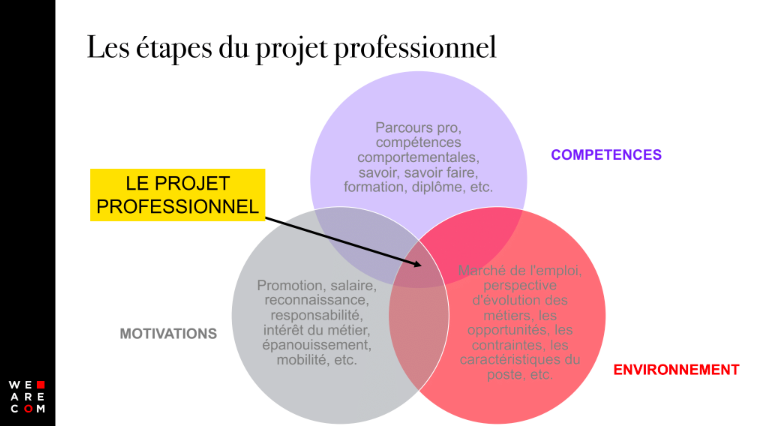
Motivations, skills, and environment should remain your angles of approach. Ultimately, It is a funnel-shaped method of thinking, which starts with the most general and ends with the most specific.
Finally, remember that you are not alone. Your career is everyone's business!
Bonus: How to choose your communication training program?
Training is essential, but it's not always easy to see clearly through the multitude of training opportunities that exist. To find THE training of your dreams :
- * Identify your needs and objectives: assess your skills and weaknesses, then determine the objectives to be achieved in the short and long term.
- * Research training options: contact specialized organizations and ask for their programs. Opt for training programs that use interactive methods.
- * Choose your training program, based on your constraints: program duration, availability, online training, in-person training, hybrid training…
Concerning the budget, which most often constitutes a hindrance, Please know that, once again, you can get help. On the one hand, your company may have a training budget, an operating budget, or a skills development fund (OPCO). On the other hand, you can personally access organizations such as the Personal Training Account (CPF), regional aid programs, and the employment agency (Pôle emploi).
Watch the full replay and tdownload the presentation materials