

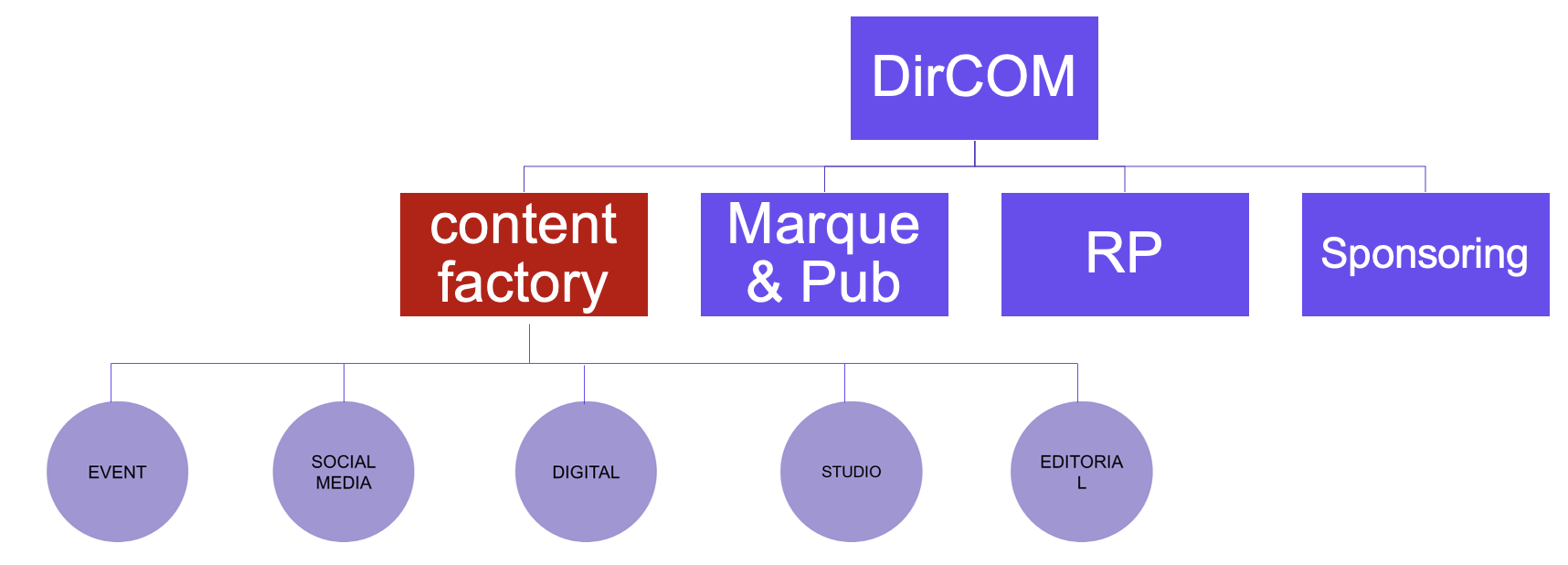
How can resources be pooled across the entire company for greater consistency and impact? To address this challenge, many communications departments are evolving their organization by "Content Factory".
But how do we put this new organization in place? In this workshop, the Club We Are COM This reveals the advantages and challenges of six models, illustrated by concrete examples from companies: Crédit Agricole, Total Energy, Société Générale, France Work, Airbus et Yogurt.
The content factory, the in-house agency serving the company
In recent years, the proliferation of communication channels across different subsidiaries, business lines, or countries has led to a loss of overall vision and control over communication by communications departments. Faced with this challenge, more and more companies have reorganized their communications teams into "Content Factories."
The concept ? Bringing together communication specialists in the form of an internal agency to meet the needs expressed by management and/or employees from the different entities of the company.
The objective? Strengthen the impact of communications by pooling team expertise, costs and content.
Advertisers are showing increasing interest in this new concept. And as proof, in 2024, 66% of multinational companies have a Content Factory and 21% are seriously considering creating one.. (Source: "Global Trends in Agency Insourcing" survey, published by the WFA – World Federation of Advertisers and The Observatory International)
However, setting up a Content Factory requires finding the right degree of centralization, coordination and subsidiarity to best adapt to the specificities and challenges of your company.
The hyper-decentralized model
In this model, the communications department focuses solely on requests originating within the department itself. Its involvement with local teams is limited to developing guidelines and charters. It leaves the production of all communications to the "local" communications teams (located within business lines, subsidiaries, or countries). Each entity has its own budget and communications team.
This model offers key advantages, such as in-depth knowledge of the target audience and increased responsiveness. It ensures effective management by local teams through their own channels. However, it also has drawbacks, such as a lack of consistency in production and broadcast schedules, as well as the absence of cost and content sharing. This model could be a transitional one, pending the expansion of the Content Factory's role beyond the Communications Department to other entities within the company.
The hypercentralized model
In this model, each entity must submit its requests to the Communications Department. The Content Factory is responsible for producing all content.
This is the assurance of a effective overall management (optimized budget and processes) with a unified voice and a consistent brand identityHowever, the risk is frustrating the local teams, who are not involved at all. There is also the danger of creating a disconnect between the message and the local target audience.
Société Générale uses this model. It has established a Content Factory with over 50 experts to produce almost all of its global communications. It also has a strategic planner to ensure overall consistency in its communications. This highly centralized model proves relevant given the stringent regulations applied to the banking sector.
The centralized model
In the centralized model, The content is produced by the Content department. Factory. Regular meetings ensure the involvement of local teams who participate in the budgeting process. Ultimately, local teams have the freedom to adapt the materials created or even create new ones (at their own expense) if those provided are unsuitable. This model...combines global communication expertise with the flexibility of local teams.
At Crédit Agricole, this approach has enabled consistent and high-impact national and regional communications.
The semi-centralized model
In this model, Local teams should seek help from the Content Factory for each project, except for highly localized initiatives.For low-impact projects, they simply need to contact anyone in the Content Factory, who will then provide them with a brief template. The local representative then pitches their request at the weekly Content Factory meeting. The Director then decides whether to accept or reject the project. The budget is shared between the national team and the local entities.
This model promotes a coherent overall strategy, control over the content produced, and optimization of budget and time. However, it can create some frustration among local teams if the project is rejected.
This approach proved very relevant for Danone, which also implemented it as part of a temporary Content Factory dedicated to their partnership for the 2024 Olympic Games.
The hybrid model
In this model, theThe communications department decides on the strategy.e. Regarding production, its role differs depending on the entity (business lines, subsidiaries, countries) and the nature of the requests. For countries, it consists solely of providing guidelines, leaving the teams to produce their own content within their available budget. For business lines, the dedicated contact within the Content Factory decides on a case-by-case basis whether to take charge of production, delegate it, or distribute it among the business lines.
While this Content Factory model may create some confusion in its mode of operation, its flexibility of intervention allows for a gradual transition towards a more assertive model.
This is the format currently used by TotalEnergies, whose Content Factory model mainly concerns editorial-type production.
The cooperative model
In this model, the Content Factory manages national projects. However, it may collaborate with local teams on certain projects, such as those involving a national client or projects that can be replicated in other regions. This approach is advantageous for companies facing significant local challenges. It allows for the support of local communications, promoting resource sharing in terms of content and budget.
France Travail (formerly Pôle Emploi) has adopted this model with its "Creative Factory", with the particularity of approaching projects from the angle of the target to be reached rather than by the choice of the channel to be used.
This contributes to to increase the quality of content and to professionalize the teams, while making savings through the pooling of costs and content.
The "glocal" model
In this model, entities have the freedom to either use the Content Factory or produce their own contentThis flexibility enhances the effectiveness of local initiatives, giving local teams the opportunity to benefit from the tools and expertise of the Communications Department whenever they need them. However, the risk is that this could lead to a multiplication of communication efforts and costs, and a lack of overall coherence.
Airbus has adopted this model, allowing it to benefit from both the overall quality of the group and the expertise of its main subsidiaries in these communications.
How to set up a Content Factory within your company?
Finding the right level of centralization isn't easy. It requires careful consideration. Here are some important points to consider when defining the best model for your business.
Defining the scope of the content factory
The first step is to define the scope of the Content Factory. Should all of your company's communications be managed within a single Content Factory? For example, Crédit Agricole has two Content Factories: one for corporate communications and the other for customer communications.
Danone, for its part, has opted for a "long-term" Content Factory dedicated to corporate communication, and another "temporary" one created specifically for their partnership in the context of the 2024 Olympic Games.
Determine its role for each entity
Next, it is important to define the role of the Content Factory for each entity (subsidiaries, business lines, countries, etc.). Will it be:
- Providing only guidelines, leaving production to the local entity, which has its own budget and communications team?
- To arbitrate on whether or not projects are carried out, and therefore to force the entity to systematically refer to the Content Factory or not?
- Should we systematically take charge of production ourselves, or leave ourselves the option to distribute or delegate it depending on the nature of the projects?
Defining the operating mode of the Content Factory
Next, it is crucial to define a clear organization and operating method:
- What is the point of entry: any person from the Content Factory or a dedicated contact person per entity or channel?
- What brief template should be provided?
- Who makes the arbitration and when (e.g., in a weekly meeting)?
- What degree of involvement is given to local entities?
- How is the Content Factory managed and coordinated (project allocation and monitoring)?
Define the budget allocation
Depending on who is capable of producing the content and the desired level of involvement from local entities, the question of budget is essential. It plays a key role in the objective of pooling resources, which is the very foundation of the Content Factory.
- At the Content Factory level only
- National/local ventilation
- At the local level only
- Budget at the local level as well
Define the stakeholders
Finally, it is essential to identify all stakeholders who need to be included in the Content Factory, and to think about how to run this organization.
- Organize meetings to promote synergy.
- Determine the appropriate frequency.
- Select an online exchange platform and use an online distribution platform.
- Plan for additional meetings involving a wider audience across the company.
In conclusion, Creating a Content Factory involves taking into account specific parameters to define a tailor-made organizational model for the company.This also requires establishing and sharing a clear understanding of the organization and its benefits to ensure its value to the teams.