

AI here, AI there… Artificial intelligence is everywhere, including in communication! 🤖 And yet, its adoption remains hesitant: Only 40% of communications professionals use it at least once a week… Why this gap between technological enthusiasm and concrete uses?
Amidst enthusiasm, questions, and organizational challenges, AI is gradually transforming communications professions. 🚀 At its AI morning event, the Club We Are COM invited communications professionals from Société Générale and Morning, who are users of AI. What's on the agenda for this round table? Inspiring feedback on the uses of artificial intelligence in communication strategies!
 Sophie Dhayer Laurent,
Head of Digital Projects and Performance, Communications Department – Société Générale

 Mathieu Philibert,
Head of design & video production – Société Générale
 Timothée Orlhac,
Content Manager – Morning
Hello to all three of you. So, “use AI", what does that mean?
Sophie Dhayer Laurent: Using AI is not always simple, especially in ultra-secure and regulated environments like the banking sector.
So, what exactly are we doing? At the Communications department, we're testing! We test new tools and study all new use cases that can bring added value to our communication professions. If AI truly allows us to gain speed or productivity, we adopt it, while always ensuring that we respect our internal processes.
Today, The group's employees have access to the internal assistant "So GPT", based on OpenAI technology and whose use is governed by a set of general terms of use. And the Communications Department also experiments with and selects new tools for these use cases.
Timothée Orlhac: Unsurprisingly, Morning is a much smaller company than Société Générale. 😀 Also, the topic of AI is more recent and less regulated. Internally, we use Dust, a software that encapsulates different AIs. By regularly feeding Dust with our language elements, we create agents specific to our needs.
From an editorial standpoint, These assistants provide us with effective support in the drafting of content, mailings or even LinkedIn posts.
On the network side, these assistants are invaluable to our 50 workspace managers, who regularly write to their clients. The result: they save time on writing, and so do we, by reducing the need for proofreading and validation. In short, we're putting AI at the service of those who communicate without being communicators.
Mathieu Philibert: Mainly, We use generative AI for graphic production and retouching purposes., whether for print or digital: MidJourney, Luma, Kling and generally all the tools in the Adobe suite, which also integrates artificial intelligence into its solutions.
To help employees become familiar with these new technologies, we have set up working groups. The idea was to "force" the teams to become interested in and familiar with AI. This may seem strange, but it was nevertheless necessary. Today, the capabilities of AI are so vast that it's important to remain curious. Monitoring and experimentation are daily activities.
Regarding video, we recently produced A film to celebrate Société Générale's 160th anniversaryIt retraces the history of the group… with a small visual challenge: two AI-generated images have been inserted. Can you spot them?
Reply : the telephone and the locomotiveThese period objects, difficult to find in traditional image banks, required significant generation work. This is precisely where AI becomes useful: it helps us create the visuals that we can't find on Getty.
What do you think are the limitations of artificial intelligence?
MP: Regarding video production, AI still sorely lacks realism.But for anything related to creativity, it can be interesting.
TO: The tone! The tone is that dial, that personal and unique style balance for each individual: sobriety, seriousness, humor… AI is more of an "anti-blank page" tool, a creative crutch enabling the efficient development of a first draft, rather than an answer in itself.
In terms of audiovisual production, realism is still very much lacking. Our main use of video tools is therefore for retouching.
S. DL.: In my opinion, one of the risks of artificial intelligence is uniqueness! AIs need to be guided and controlled by human intelligence, so as not to fall into uniformity. These new tools are extremely effective partners when it comes to saving time, but they will never be able to replace human creativity, a creativity that results from context, experience, emotions and reason.
I would add thatWe must remain vigilant against biasesSince we give our own biases to AI, we must be careful not to reinforce or reproduce them unconsciously.
How do you instill the AI mindset in your teams?
TO: There's no secret, You have to force yourself.😀 We're organizing workshops to create new assistants and continue to train existing agents. As for the rest, we move forward together as peersby sharing our use cases and best practices.
S. DL.: We invite external speakers in order to familiarize employees with artificial intelligence and organize in-house training To introduce communicators to best practices, especially those related to prompts. How do you create a prompt, and a prompt for a prompt, and a prompt for a prompt for a prompt? 🙃
MP: The other day, a colleague told me, "AI, that's all you ever talk about!" That says it all! 😀 Anyway, Artificial intelligence is one of our objectives; we must get started on it. I've made it a habit to share numerous use cases with my teams. I'm convinced that when curiosity isn't enough, you have to try to get people on board through concrete examples.
Timothée, can you tell us about Morning's latest campaign, created using AI?
TO: In general, we deploy a communication campaign per year. This year, we wanted to take a step back, to make our message more accessible, in an original and unconventional way. Our brief? To visually stand out in the Paris metro, breaking the rules and without riding the wordplay trend, all without a budget.
The idea that appealed to us was this slightly absurd way of reminding us how wonderful it is when everything works in the office!
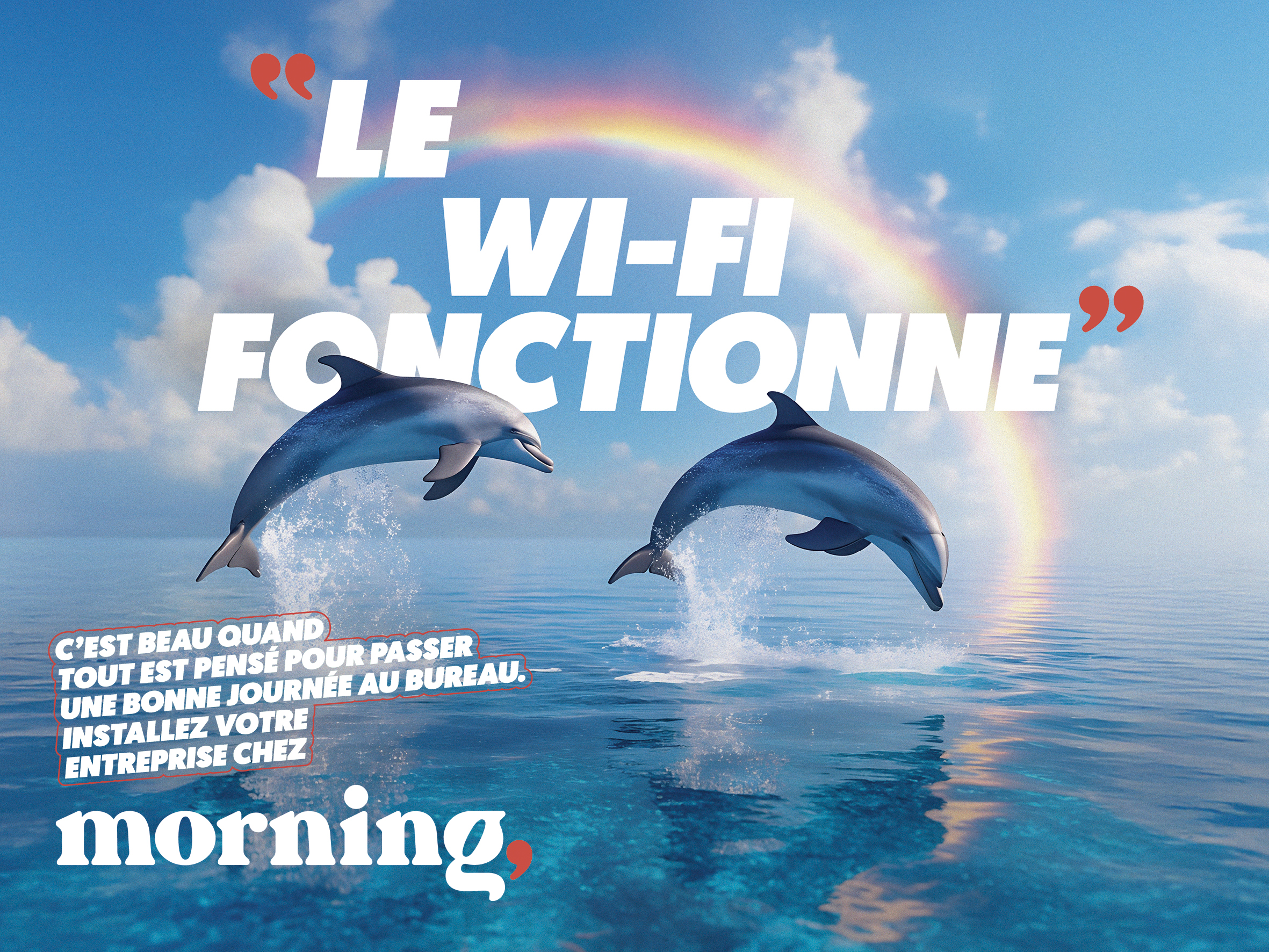
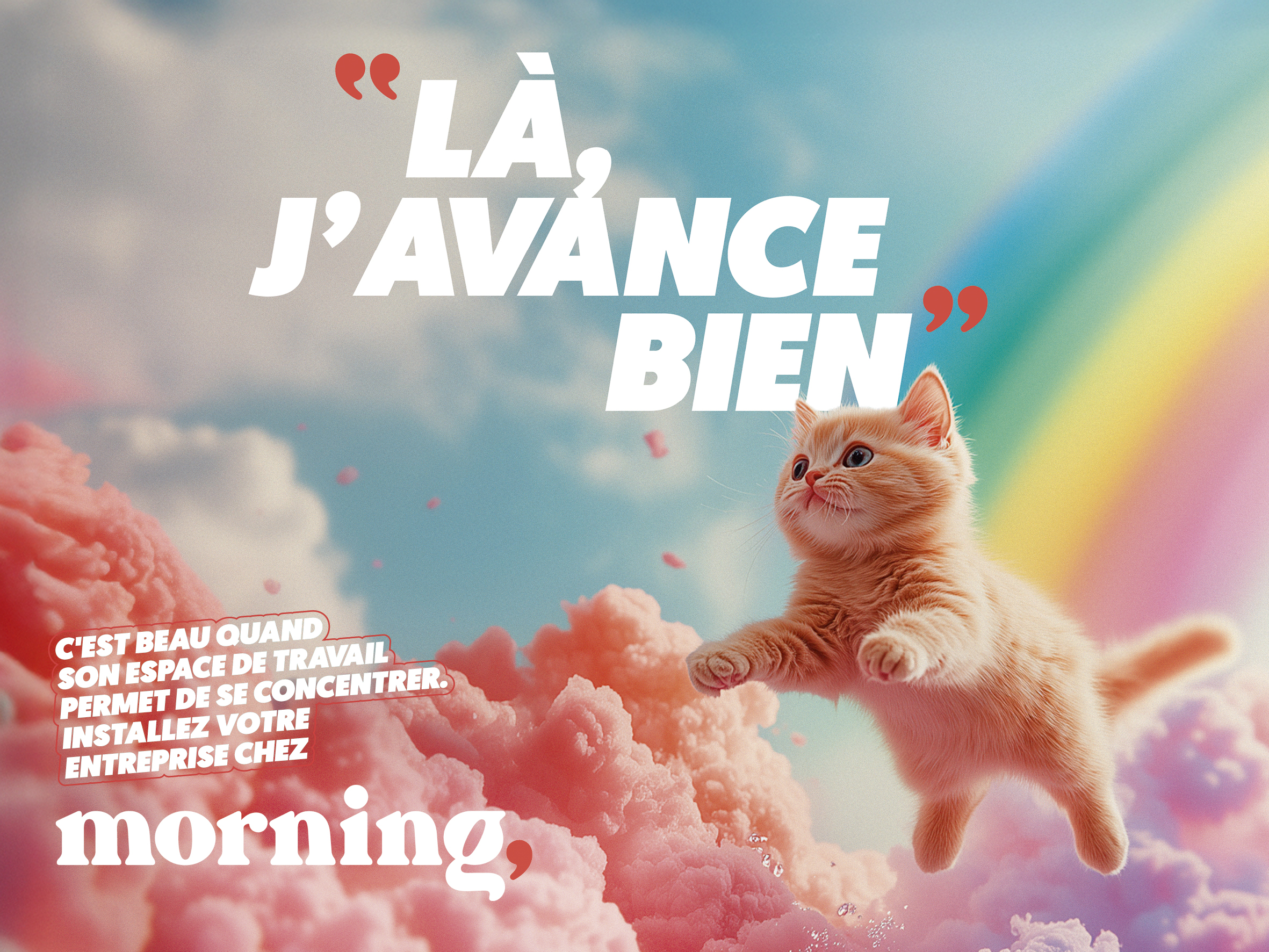

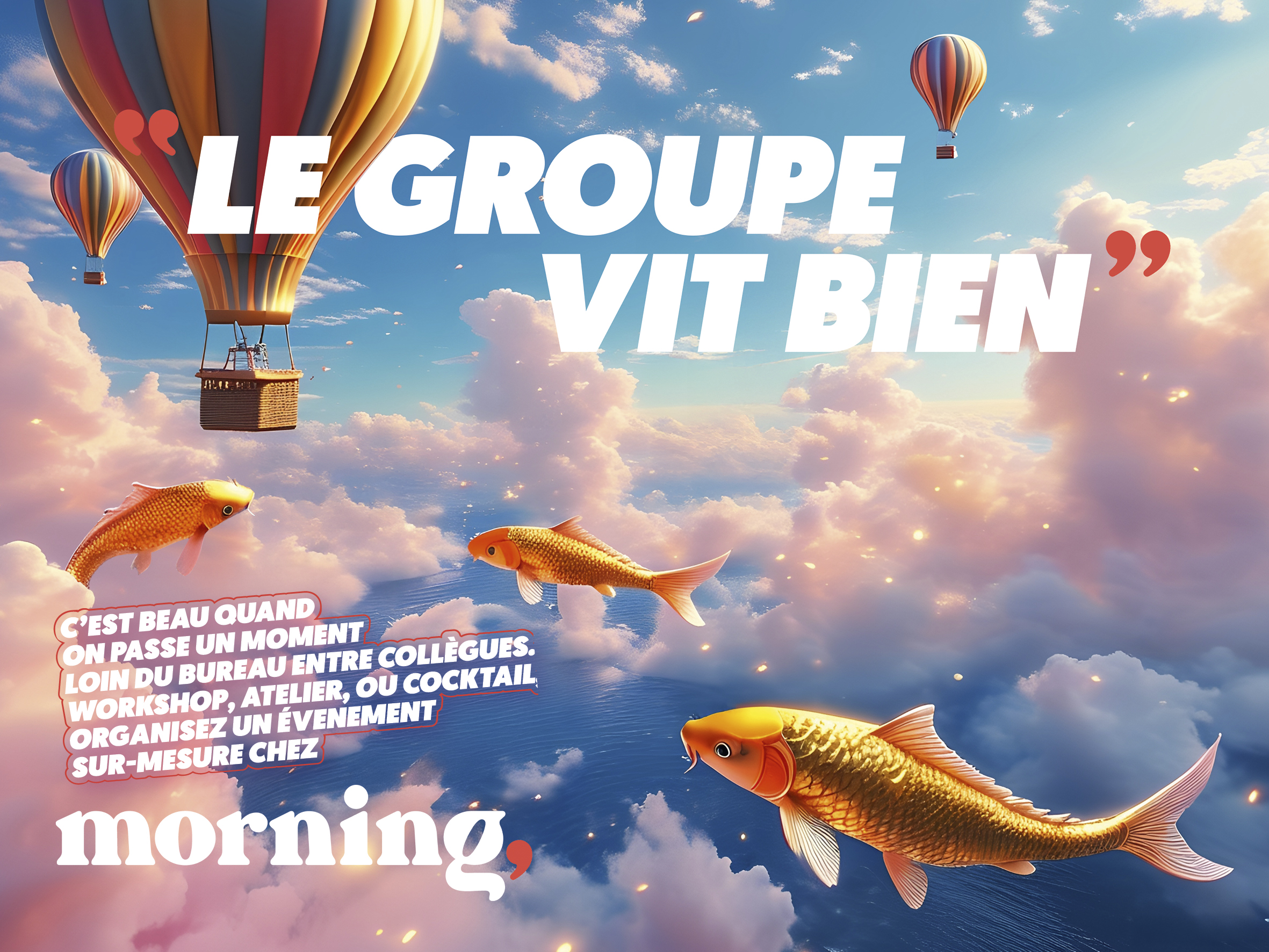
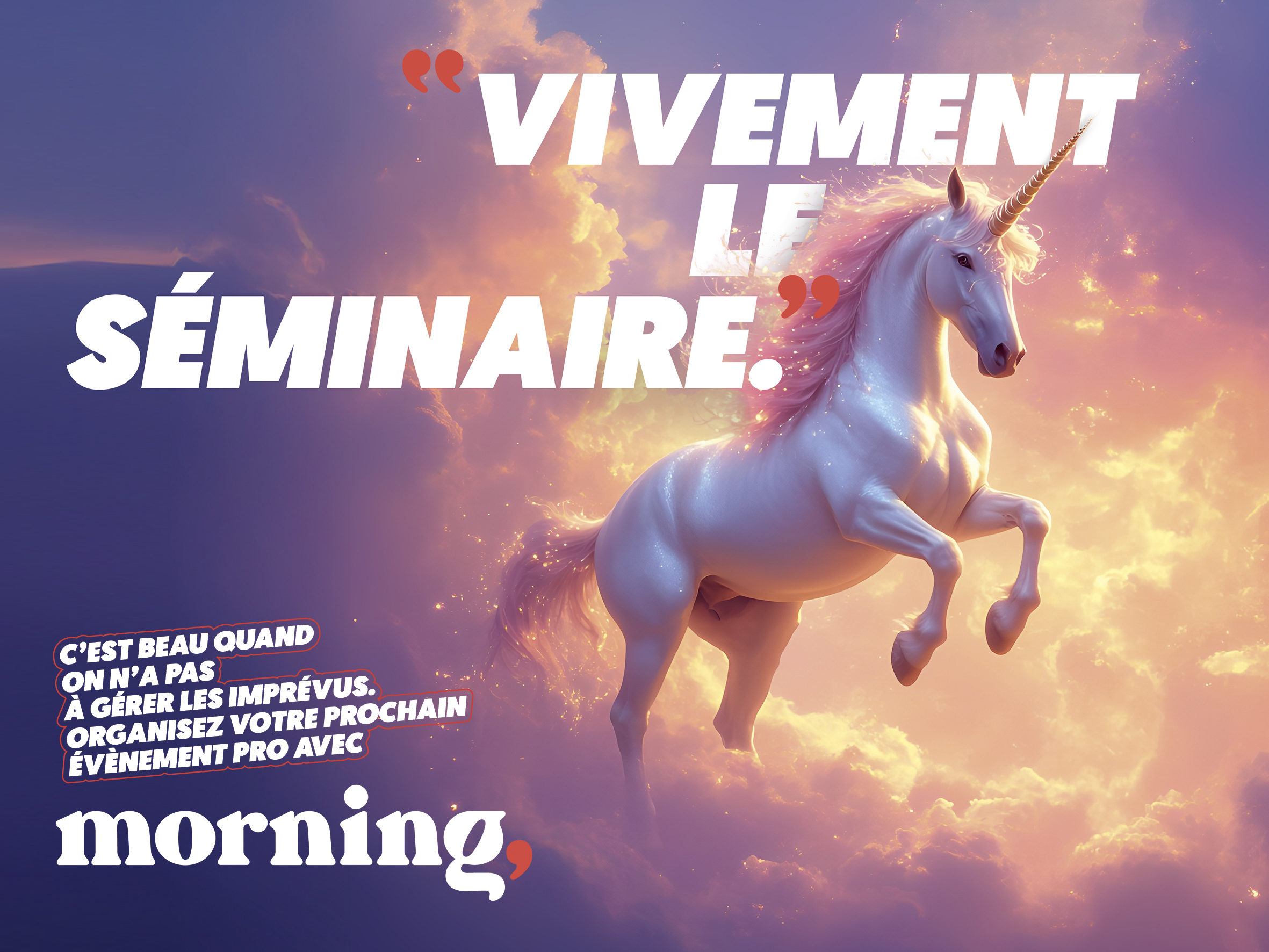
We took the risk of venturing, on behalf of the company, into a society where AI is still a subject of debate. Our behind-the-scenes video for digital media has also generated considerable buzz. Social MediaBut even if this campaign doesn't please everyone, we dared to play with the new tools and we're delighted with the results.
Sophie and Mathieu, at Société Générale, how do you use artificial intelligence?
MP: For the group's 160th anniversary, we organised an exhibition – both real and virtual – composed of photos of our bank's biggest clients from all corners of the world. It was barely three days before the opening of the physical exhibition that AI came to our aid.
Indeed, under each photograph was a QR code linking to a podcast in which the customer in question discussed his story with Société Générale, content available in French and English. The last-minute request? To preserve the speakers' voices in both versions. Thanks to the Lipitt tool, we were able to accomplish this in record time.
S. DL.: The role of the digital communications department is somewhat cross-functional, We provide teams with new solutions to improve efficiencySome employees embrace it, others less so; each person adopts the new tools in their own way.
- An editorial agent : to optimize both writing and SEO.
- A chatbot for our intranet: which will be able to answer all employee questions in the manner of an intelligent search engine.
- A support agent : to respond to contributors to our various web platforms, to free up valuable time for our communication teams.
- A translation agent Soon, all our intranet content will be available instantly in all languages. Of course, we will specify that the different versions were generated by artificial intelligence.
What comes next? Predictive AI will help us detect weak signals and analyze our performance. Ultimately, artificial intelligence makes it possible to automate the simplest and most repetitive tasks, to the benefit of higher value-added projects.
Finally, what are the major challenges facing AI in the coming years? Do you have any advice for the members of the We Are COM Club?
S. DL.: It's paradoxical, but with AI, We waste a lot of time trying to save time! 😀 Today, we spend a large part of our time in test and learn, so we need to be patient.
In a world where AI can inspire fear in some people, I would say that The biggest challenge is getting people on board: getting both management and teams to buy in.And surprisingly, the reluctance towards these new technologies is not generational.
TO: Indeed, it's funny, but younger people are not the most inclined to train in artificial intelligence.
AI is a tool that must be mastered in order to gain efficiency. They will never replace human beings, their discernment, personality and creativity, but they can be true, ultra-inspiring and challenging foundations for all your projects.