

GEOThree letters that could very well revolutionize your content strategy. Generative Engine OptimizationIt's the art of making oneself visible… in the eyes of artificial intelligenceBecause now, it's not just internet users who need convincing, but the AIs themselves. How can you be cited in their responses? What kind of content do they favor? And what can be done about the drop in clicks?
Discover the advancements in AI-driven research and the new practices to consider in your editorial strategy ✍🏻
Watch the replay 📹 Download the slides 🗂️How AI is transforming research
Web search is changing its face
No more cascading results and clicks to the first page that appears. Generative artificial intelligence is changing the game. by directly providing concise answersDesigned using multiple sources, they provide an immediate response, eliminating the need for the user to visit an external website.
New specialized search engines like Perplexity AI are emerging and already influencing how we use them. Their promise? A more interactive, more contextual search, capable of dialogue and refining resultsThis model is now inspiring giants like ChatGPT or Mistral, who are integrating AI search functionalities into their interfaces.
Google shaken, Google reacts
For the first time since 2015, Google falls below the symbolic 90% global market share markThis trend has been confirmed since the end of 2024, with an even more pronounced decline in the United States, where the engine's dominance is openly challenged. Faced with this dynamic, a counter-offensive has been launched: AI Overviews to synthesize the research and AI Mode To handle complex queries, they're leveraging Gemini 2.5, their latest in-house AI model. These features, deployed in several countries, are not yet available in France… But the process has begun.
The illusion of being number 1
The deployment of AI Overviews radically alters the hierarchy of resultsAccording to an Ahrefs study conducted in April 2025, Position 1 on Google loses up to 35% of clicks when an AI answer is displayed.
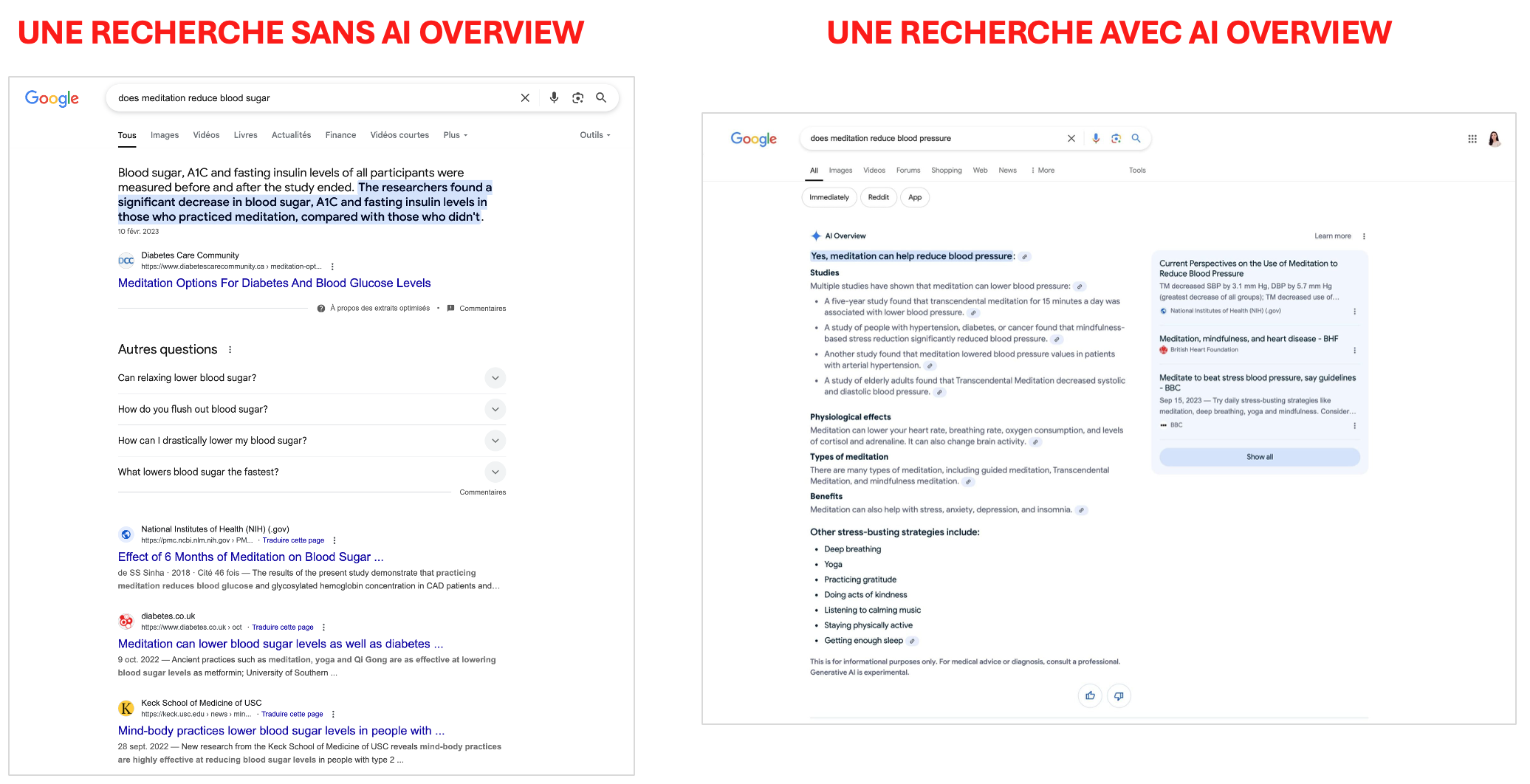
And the cited content doesn't just come from the top results. Since a key update in March 2025, Google has been extracting information well beyond the first page, sometimes as far back as the 100th position. According to BrightEdgeNearly 9 out of 10 cited sources don't even appear in the top 100. Other studies (botify – April 2025), are less “alarmist”: 90% of the links cited in the AI overviews would fall between results 1 and 35. In both cases, the signal is strong: Classical optimization is no longer sufficient.
New requests, new uses
The presence of an AI summary transforms search habitsInternet users are interacting less with traditional links, preferring to read the displayed response directly. Even the best-ranked sites lose visibility.
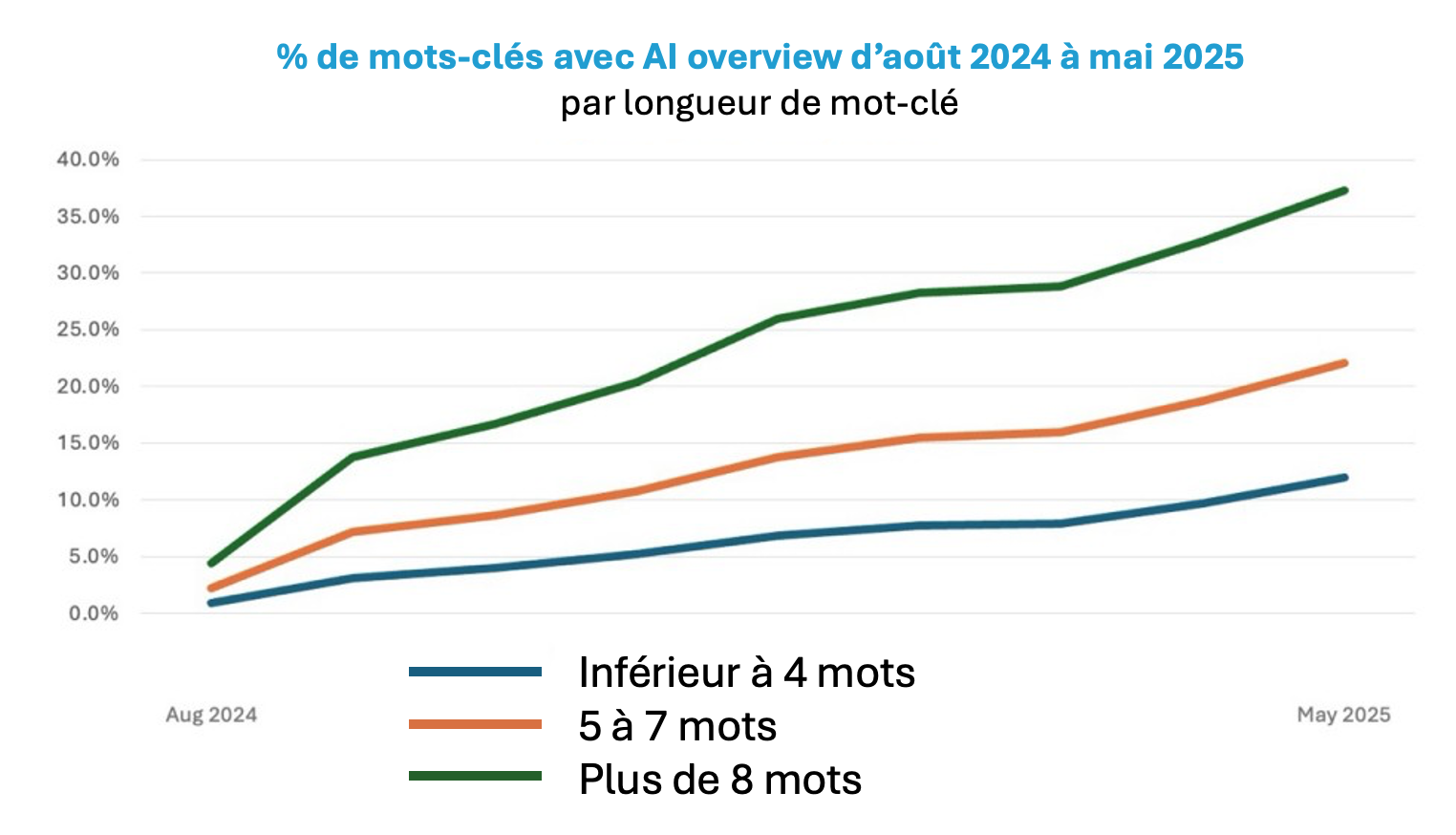
Another change: the length and complexity of the queriesMore technical and specific, they frequently exceed eight words, with a strong increase in sectors such as healthcare, finance, and engineering. A more conversational, more demanding… and more selective search.
Brands: between loss of control and new levers?
This revolution raises major challenges for communicators. If AI itself provides the answer, the source website becomes secondary—or even invisible. Some estimates suggest a 40 to 60% loss of traffic for sites that fail to get cited. Faced with this new reality, the priority becomes being present in AI responses. Being cited, and cited accurately, is crucial. Because if erroneous information circulates, few users will bother to verify it elsewhere. Hence the importance of solid, structured content and an active monitoring strategy.
GEO, or Generative Engine Optimization, then emerges as a lever for action: Rethinking content, working on long-tail keywords, structuring key information, and strengthening brand credibility. A new balance to be found, between algorithms and audience, between visibility and authority.
How does GEO work?
GEO vs SEO: continuity or rupture?
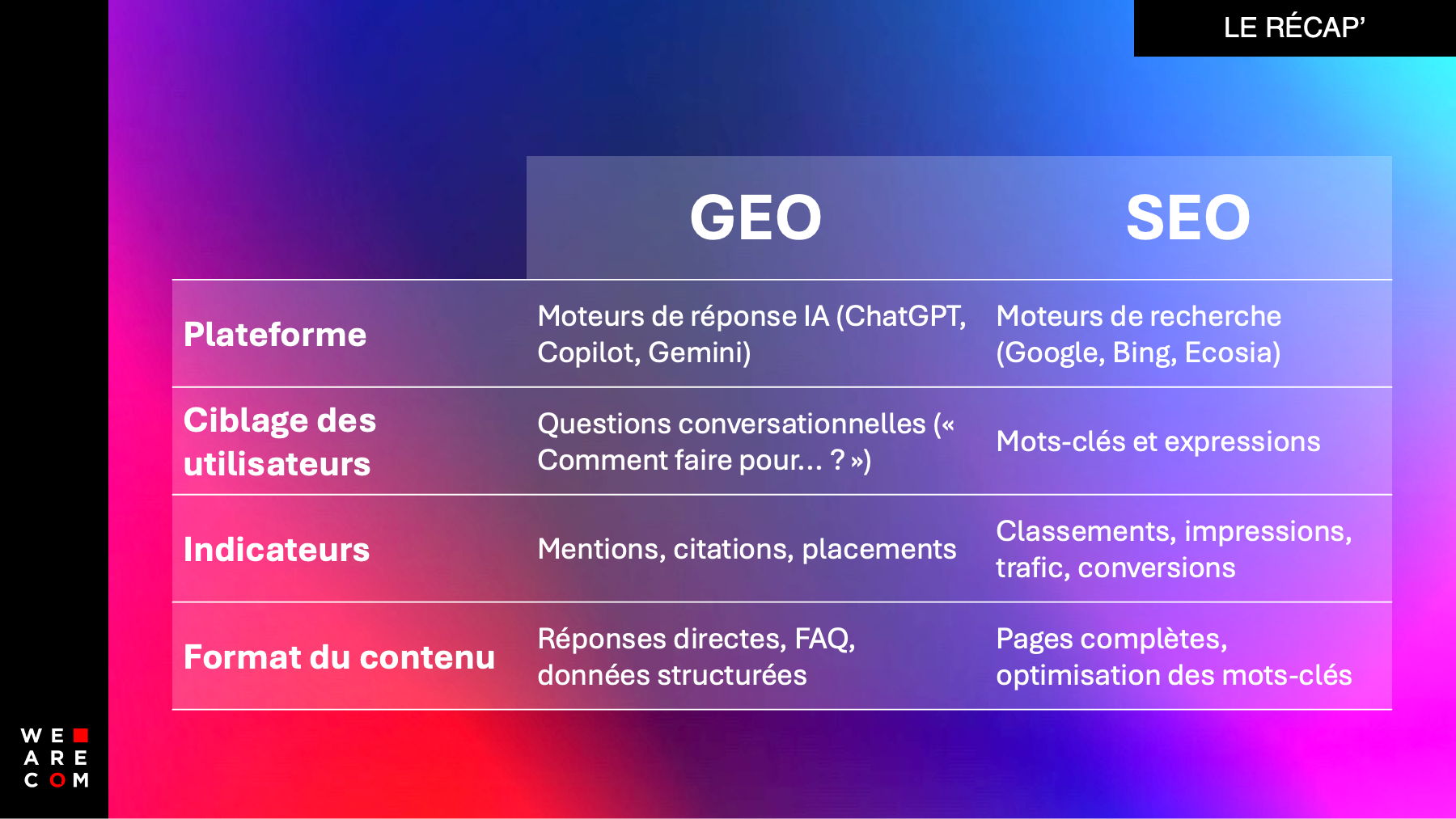
GEO is an evolution of SEO. which retains the same basics – visibility, keywords, content quality – but changes the rules of the gameThe goal is no longer to appear at the top of the results page, but to be quoted in the AI-generated responseThe famous “position zero” is no longer occupied by a link, but by an AI-generated summary, populated with content deemed relevant. Traditional search engines classified; generative search engines compose. Success is no longer measured solely in clicks, but in presence within recognized sources and those referenced by AI..
GEO, Google's advice (Spring 2025)
In May 2025, Google shared its 8 key tips for optimizing your presence in AI Overviews and AI Mode. These recommendations are in line with traditional SEO, but with an AI perspective:
(I.e. Create genuinely useful content : to respond to specific intentions, with clarity and reliability.
🧭 Improving the browsing experience : a user-friendly, fast website, designed with the user in mind (special mention for mobile!)
🔍 Allow Google easy access to content : no technical barriers or inaccessible areas.
🧱 Structure the display in the results Titles, tags, excerpts… Everything counts for readability.
🧩 Align structured data and visible content : no discrepancy between what is announced and what is read.
???? Focusing on “multimodal” Texts, images, videos… The more varied the (types of) content, the greater the chance of being visible
(I.e. Understanding the “value of visits” : no longer focusing solely on clicks, but on presence in AI responses.
(I.e. Preparing for future developments AI is moving fast, strategies will have to keep up!
🧑🏻💻 Understanding the value of visits
If Google is urging us to "stop focusing on clicks," it's because we're witnessing "The Great Decoupling": whereas previously clicks and impressions were relatively aligned, we now get tons of impressions, but nobody is clicking anymore.Positioning oneself on the different AIs
AI overviews are an opportunity for brands. They are visible on nearly 50% of search queries (US). Sources can benefit from a boost in clicks or reputation (according to initial studies) especially since the research often seems more "engaging" (close to a final action/decision).
Intention takes precedence : Google displays the AI overview much more often for informational questions (“how”, “why”, “what is…”) than for commercial questions: about 6 out of 10 times for informational queries, but only 2 out of 10 times for immediate purchase expressions.
The “long tail” prevails Give Google a 5-word query or one that generates fewer than 1,000 searches per month, and the overview will appear most of the time (approximately 73% and 55% respectively). Producing more specific content, aligned with new search trends, therefore seems like a winning strategy.
ChatGPT
ChatGPT favours established and factual sources, notably Wikipedia (27% of citations)Media outlets like Reuters and the Financial Times are also favored, as they are partners of ChatGPT. However, user-generated content and blogs are almost entirely absent. To improve your visibility on ChatGPT, it is recommended that you To strengthen your credibility, be present on neutral sources like Wikipedia and prioritize non-commercial information.
Perplexity
Perplexity seems emphasize the expertise and up-to-dateness of the information38% of the quotes come from blogs, 23% from news sites, and 9% from "domains known for their expert opinions." User-generated content (UGC), while not representing the majority of quotes, remains more used than on ChatGPTIt is advisable to "cultivate your presence on high-authority niche sites and on respected and relevant review platforms for your sector."
GEO: Write to be quoted, not simply "ranked".
Overall, generative AIs only need one impactful sentence from you, so make sure it's impossible to miss:
- In the first 100 words, answer the main question clearly in a single sentence.Ensure that this response is self-contained, meaning that it can be extracted by AI without additional context.
- The lists help the model identify the steps, statistics, and definitions, so that it uses your own words rather than someone else's.
- Avoid vague pronouns such as "this", "that" or "it" when the reference is not obvious, because AI can confuse them.
- Quote one source right after a statistic And add links from time to time. This strengthens credibility.
- Stick to the H2 and H3 tags. The clearer the plan, the easier the quote.
To be a trusted player
Google's AI loves pages that look trustworthy. Here's how you can build that trust in a few steps:
- Create a direct link to the original study, the official document or data you are citing, ideally, right after the statistic or quote.
- Sign the articles Include the full name, job title, and a line describing qualifications (e.g., "Over 10 years of experience in technical SEO"). A short author biography or a link to their page helps the search engine crawler confirm their expertise.
- After a key statement, add a parenthesis such as "(Verified in Google's documentation, May 2025)." The AI often quotes this exact wording because it indicates that the information is recent and confirmed.
- Choose your links carefully A link from a blog or industry association can be worth more than ten random links.
GEO: New metrics?
Goodbye to tracking rankings and clicks from Google results? The impact of geo-targeting seems more complicated to monitor these days. Here are some indicators to consider:
- Print share Frequency with which your content appears in AI previews
- Brand mentions Total number of mentions of your site
- CTR of AI overview : number of clicks you get from the preview box
Currently, Google Analytics does not allow tracking of your page views in the AI overview. Other tools such as SEMrush ou Otterly AI (Paid) services offer this option. However, you can identify AI sources (ChatGPT, Perplexity, etc.) yourself to have them appear in a specific category in your Google Analytics console. by following this tutorial.
✨ Meet-up recap
📹 The replay and the presentation materials for the meet-up