
CSR, IA, influence, regulation… The lines are moving, the benchmarks are evolving, expectations are accelerating. Faced with these major changes, communicators no longer have the role of just a conduit, but also a builder. Builders of stories, trust, impact — and sometimes even frameworks.
 On the occasion of the release of the 10th edition of the CommunicatorThe We Are COM Club, the profession's reference work, welcomes Celine Mas for an exclusive exchange. Objective? To gain perspective and pave the way for the major challenges that are reshaping the future of communicationFar from fleeting trends, close to the ground. A look back at an intervention where conviction, vigilance, agility… and a desire to act intersected 🚀
PART 1: Communication, from ideas to action
1 – The communication plan
The big trend of the moment? Rethinking the communication plan in light of a VUCA worldThis acronym, inherited from American military vocabulary, designates an environment marked by Volatility, Uncertainty, Complexity, and Ambiguity. In other words: traditional reference points are shattered. There is no longer any question of rolling out a linear and fixed COM plan for the coming year. Make way for adaptive strategy, multiple scenarios, and agility in execution. The communicator becomes a strategist of movement, both a scout and a compass in an unstable world.
In this changing landscape, another transformation is taking place: the blurring of boundaries between communication, information, opinion and entertainment. Who is speaking? From where? And with what intention? The average citizen-consumer can no longer always distinguish a sponsored post from editorial content, an opinion piece from a factual report. The proliferation of fake news only makes matters worse. As a result, the battle is no longer fought solely on ideas, but on attention, credibility, and clarity.
Finally, another major development to watch closely: the legalization of communication. Image rights, GDPR, intellectual property, accessibility laws, influencer regulations… and, in the area of future prospects, the framework for generative artificial intelligence.Today's communicator can no longer ignore the law: they must integrate it into their strategy as a partner. My advice? Take the time to read (at least skim) the European regulation on AI. It's a new chapter in our professional responsibility.
Make way for adaptive strategy, multiple scenarios, and agility in execution.
2 – Communication evaluation
The impact of communication can be measured; it safeguards the responsibilities and contributions of each individual. An adaptation of Maslow's pyramid helps to define the objectives of COM: to make known, to make understood and to gain support. And it is from this that each communicator can identify their responsibilities and contributions, at the level of their team, their department and their organization.
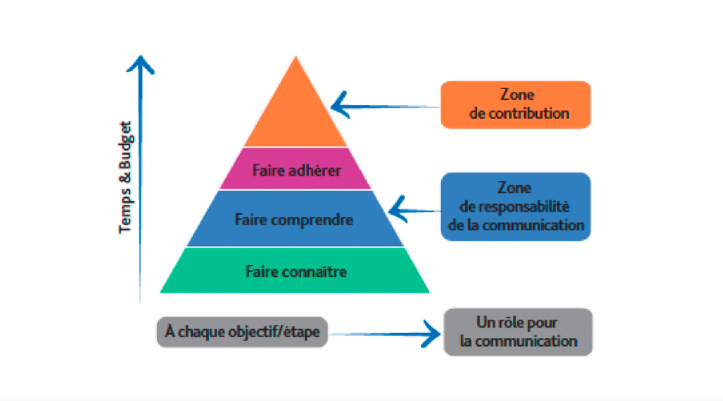
More specifically, in terms of evaluation, the latest edition of Communicator 10 identifies 5 notable trends:
- Accelerating data processing particularly with artificial intelligence and its speed of execution.
- The generalization of evaluation: Whether for resource-related or strategic reasons, all brands will eventually assess their impact.
- The integration of CSR KPIs : responsibility is now an integral part of the evaluation process.
- Ethics An evaluation must be based on a sound methodology. This is the guarantee that the figures cannot be made to say just anything.
- The challenge of collecting quality data: Data quality has become a priority. But how can we ensure it in all circumstances?
3 – The logo and the brand
Brand identity today is expressed on several levels: visual, auditory, sometimes even olfactory. Added to this are questions of execution: eco-design or artificial intelligence?
Eco-design is not limited to climatic variables. It is essential that human rights be respected throughout the entire design process. For example, on a photoshoot, even abroad, French rights must be upheld.
Regarding AI, many questions arise. Can artificial intelligence generate a "good" logo? While AI is certainly revolutionizing design costs, at whose expense and what? To design an impactful visual identity, I recommend using professionals, even if they sometimes use AI.
Branding is a topic we could discuss for hours. But to keep it brief, it seems to me that four points need to be considered.
- The Pacte law Companies now have a purpose; increasingly, they aspire to be "mission-driven" and are structured around dialogue. By fundamentally influencing brand strategies, these changes directly impact communication professions.
- The financial value : on the evaluation side, techniques now exist to measure the intangible assets of brands.
- Sustainable design : design is being rethought in a broad sense and is incorporating many new constraints, particularly climatic ones.
- Employer branding Brands want to recruit and retain talent. Employer branding and HR communication are now among the key disciplines in our professions.
While AI is certainly revolutionizing design costs, at whose expense and at what cost?
4 – Advertising
It wasn't until the 10th edition of Communicator that a chapter dedicated to advertising appeared. Why? Because contrary to popular belief, The advertising market is holding up relatively well in the current economic climate. Advertising investments are increasing significantly in France, particularly with regard to digital advertising.
What future prospects for the profession does this chapter highlight?
- An evolving approach to audiences The "personas" are constantly evolving; today's consumers are also citizens and collaborators. Add to that increasing regulatory challenges and the fragmentation of channels, and designing impactful strategies becomes increasingly complex.
- A revaluation of the narrative Even under constraints, it is possible to create creative narratives. Have you heard of the "paradox of fruitful constraint"?
- An uncertain promotional item How can we create connections in a world where promotional items are disappearing?
- AI-fueled creativity : super agile communication operations are dethroning large, super expensive campaigns.
- The post purpose : behind this "technical" term lies the idea that CSR is becoming organic, and no longer simply theoretical.
And what about communication in the future?
And of course, we discuss new technologies. Should we go? Obviously, but not just any old way. Communicators must intelligently select the tools best suited to their brands.
At the same time, ROE – Return On Emotion – is gaining momentum. It has become essential for a brand to be able to generate emotions alongside data.
PART 2: Communication professions facing a new reality
1 – The jobs of internal COM
This is perhaps one of the professions that has changed the most in recent years.Today, the employee has become a true player in the brand narrative, and internal communication must become even more creative.
Managerial communication is also reinventing itself. Did you know that 7 out of 10 employees would seek information related to the group from their managers? Increasingly, the frontline manager is under enormous pressure; they must give meaning to everything, while also acting as a link between the teams and the Executive Committee.
Finally, internal communication is a lever for cohesion in a social climate that is complex to say the least, especially in France.
2 – Public Relations Professions
How to build trust with stakeholders? How to restore credibility to brand messaging? To be believed and followed, press relations are innovating.
Far from the traditional press conference, PR communicators are rethinking the event. Today, the event is a media outlet in its own right. New formats, new methods… In financial communication, the classic and ultra-regulated discipline is once again getting a makeover.
3 – The professions of influence communication
Influence communication is also undergoing a transformation. Backroom lobbying is no longer relevant. Corporate social responsibility (CSR), and the transparency it demands, are challenging this old, highly confidential approach.
How do we get the population on board, across all categories? By being clear about our intentions and how we conduct lobbying. Today, communicators must combine expertise, integrity, and political strategy to craft narratives that engage citizens. Ultimately, the stakes of communication are also becoming democratic!
4 – Careers in Digital Communication
Websites and social media… Digital communication is a whole universe in itself, encompassing global communication. The tools are interconnected, and online reputation is managed in real time. It's a new way of approaching communication, organically, transparently and proactively.
5 – Crisis Communication Professions
Similar to online reputation on social media, The crises are becoming faster and more visible. A poorly managed PR disaster can trigger a major emotional crisis. That's why crisis management must be proactive and continuous, without neglecting the recovery process. The key word? Storyproving!
How can you distinguish between moderate tension and a real crisis that will profoundly damage a brand's credibility? This is a real challenge for communications professionals, because It becomes very difficult to precisely identify the elements that transform a small spark into a widespread fire.
6 – Responsible Communication Professions
The issue of responsibility is both a regulatory constraint and a societal expectation. Certainly, if declining purchasing power does not always allow for responsible consumption – particularly because of purchasing power – this does not prevent it from remaining extremely sensitive to this issue.
It is up to communicators to find the right balance between responsibility and creativity, without sacrificing the brand narrative. The COM must guarantee the legal framework, acting as both a revealer and a facilitator. I am convinced that responsible communication does not have to be boring.
PART III: And the sector?
Understanding the communications sector is essential for joining it. This ecosystem represents a significant economic force, a relatively stable and resilient asset despite the various crises of recent years.
In terms of changes, budgets allocated to CSR, internal communications, and digital are increasing, data is disrupting our ways of working, and communications departments are increasingly focusing on transformation. Indeed, 87% of the Communications Departments are undertaking or considering a transformation.
The communications director, for his part, has become a conductor, simultaneously a strategist, mediator and value creator. However, despite a strong context of crises, this professional is still too often excluded from the Executive Committee and the Management Committee.
Finally, communication strategies are structured and hybridized around 3 main models:
- The Newsroom model As in the media world, this model oscillates between timely and timely content. The Communications Director then takes on the role of an air traffic controller, providing employees with a comprehensive overview. This model guarantees responsiveness and consistency, but it can sometimes prove to be a bit too two-headed.
- The Counter Model In this scenario, the Communications Department acts as a liaison for the other departments within the group. This hub, directly connected to other business units and led by the Head of Communications, ensures the clarity, personalization, and effectiveness of communications. The limitation of this model? The need for dual expertise.
- The Influence Hub model In this model, stakeholders take priority. Structured and functional, these communications departments aim to create value through a deep understanding of their audiences. Adopting a listening approach, the communications director acts as a mediator of opinion. However, care must be taken not to develop an overly matrix-like organization.
🎥 The workshop replay and the presentation support

Illustration visual: Midjourney