

A bad buzz, a technical incident, poorly controlled speaking… The crisis is not an exception, it is a reality that every organization must anticipate. And in these moments of tension, communication becomes a decisive strategic lever.
 During a workshop of the Club We Are COM, the expert Fabienne Laurenceau, consultant in strategy and sensitive communication, shares her 20 years of field experience Decision-making processes under pressure, the communication style, stakeholder engagement… Everything is covered, with no holds barred. A valuable exchange to rethink your reflexes in tense situations and strengthen your prevention culture!
1 – Does truth exist in a crisis situation? Or must we accept that there are multiple truths?
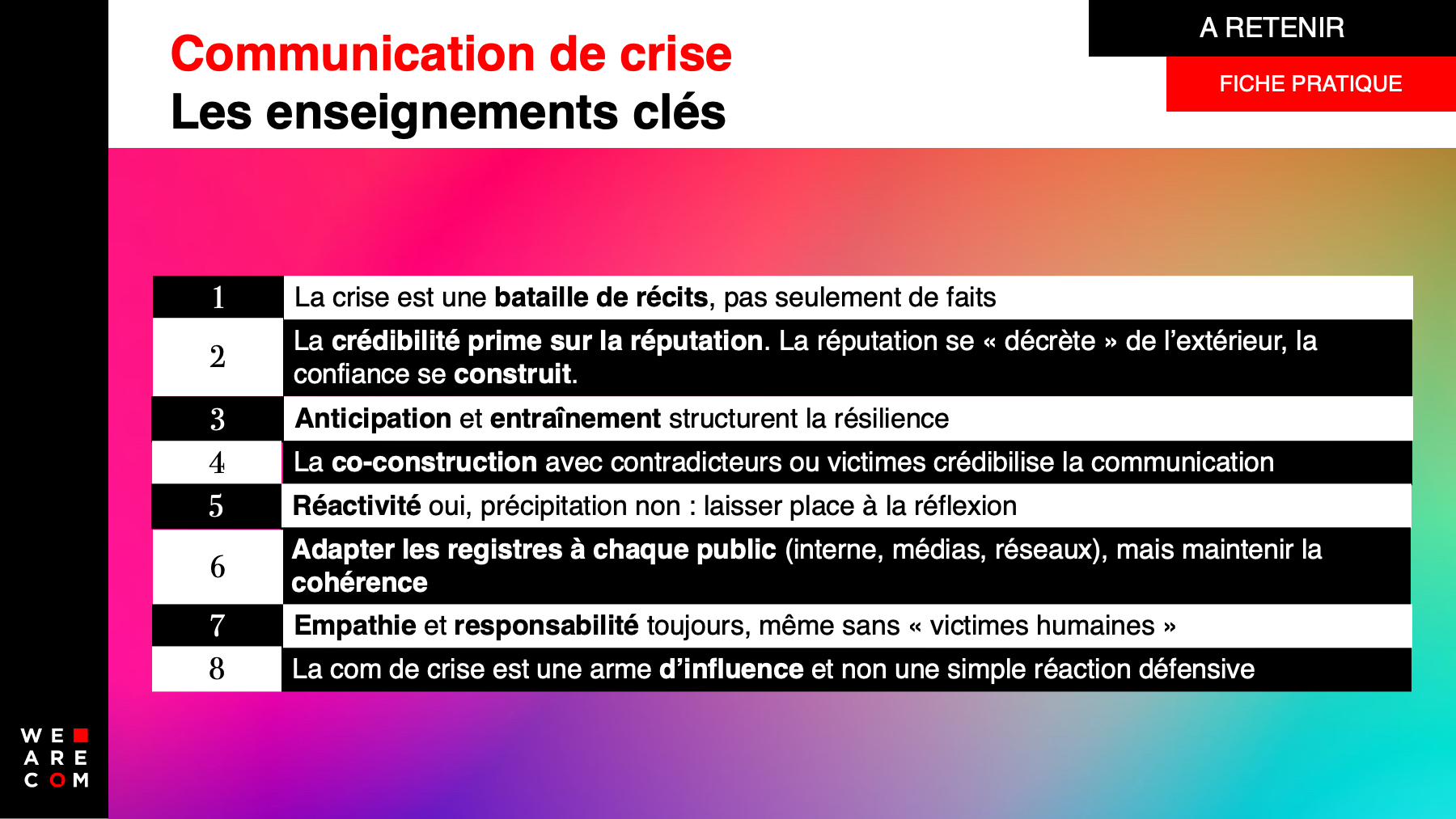
Does truth truly exist in a crisis situation? Truth, no, truths, yes. In crisis management, there are as many truths as there are stakeholders, because these truths are intimately linked to each party's perceptions.And it's not necessarily yours that will win, but the one that resonates with the majority, that evokes the most emotion in your audiences.
We must remember that a crisis is first and foremost a human situation, which generates fears or anger, and that truth is built on feelings and perceptions. To ensure everyone feels valued, it's essential to place the human element at the heart of the process. The choice of a word, a visual, a spokesperson… Every detail must be considered in light of the emotions it evokes and the desired effect. In other words, Communication does not have a monopoly on truth.
Does truth truly exist in a crisis situation? Truth, no, truths, yes.
2 – How is credibility different from reputation?
I am convinced thatWe need to stop chasing after this "damn" reputation. It doesn't belong to the brand, it's not built within the communication departments… A brand's reputation is what others say about it.
What communication should aim for is credibility. A credible brand that inspires trust is what will ultimately impact its reputation.
To consolidate one's credibility, it is important to consider the context in which one communicates: an atmosphere of distrust, a media record… And remember that credibility is not synonymous with legitimacy. A legitimate spokesperson is not necessarily a credible spokesperson. If reputation depends on the opinions of stakeholders, why not give them the opportunity to express themselves and involve them?
Credibility does not rhyme with legitimacy.
3 – What are the fundamentals for effective crisis management?
The major difference between an organization that collapses and one that remains standing after a crisis is anticipation! Thinking about a crisis before it happens is already a way to limit the damage.
Identify possible scenarios, anticipate how they might evolve, and practice beforehand. Even if a crisis never unfolds exactly as envisioned, being prepared means being more responsive. Depending on the type of crisis, you'll know which stakeholders are involved, what issues are at stake, and therefore what kind of communication strategy to implement.
Beyond structured crisis management, I recommend continuous monitoring. Too often, I observe that monitoring is neglected, even in large organizations. Monitoring is essential; it must focus on weak signals, all signals that could, directly or indirectly, have an impact on your stakeholders.
From the stakeholders' perspective, the relationship you maintain with them is crucial. There is nothing worse than discovering new interlocutors in the middle of a crisis situation. Your ambassadors, your opponents, the media… Every strong relationship must be built over time.
Finally I advocate for co-creation. An organization is not the only one impacted by a crisis. Therefore, in the interest of mutual respect and constructive involvement, consider all those affected and consider their different perspectives. You will see that this can prove very useful.
Even if a crisis never presents itself as we had imagined it, being trained means gaining in responsiveness.
4 – How to reconcile responsiveness and discernment under pressure?
As is often said, speed should not be confused with haste. A crisis decision made in less than 5 minutes can impact a brand for 50 years. That's why it's important to take the time to challenge your ideas.
We need to analyze the context, but also look ahead, identify the challenges and the levers for change. The origin of any crisis is very quickly forgotten. What matters most to the general public is how this bad publicity is managed, the communication that is deployed. In my opinion, good crisis communication is communication of influence.
I think it is important to remember that communication can accompany a crisis, or even enhance it, but it can in no way manage it without a crisis management strategy.
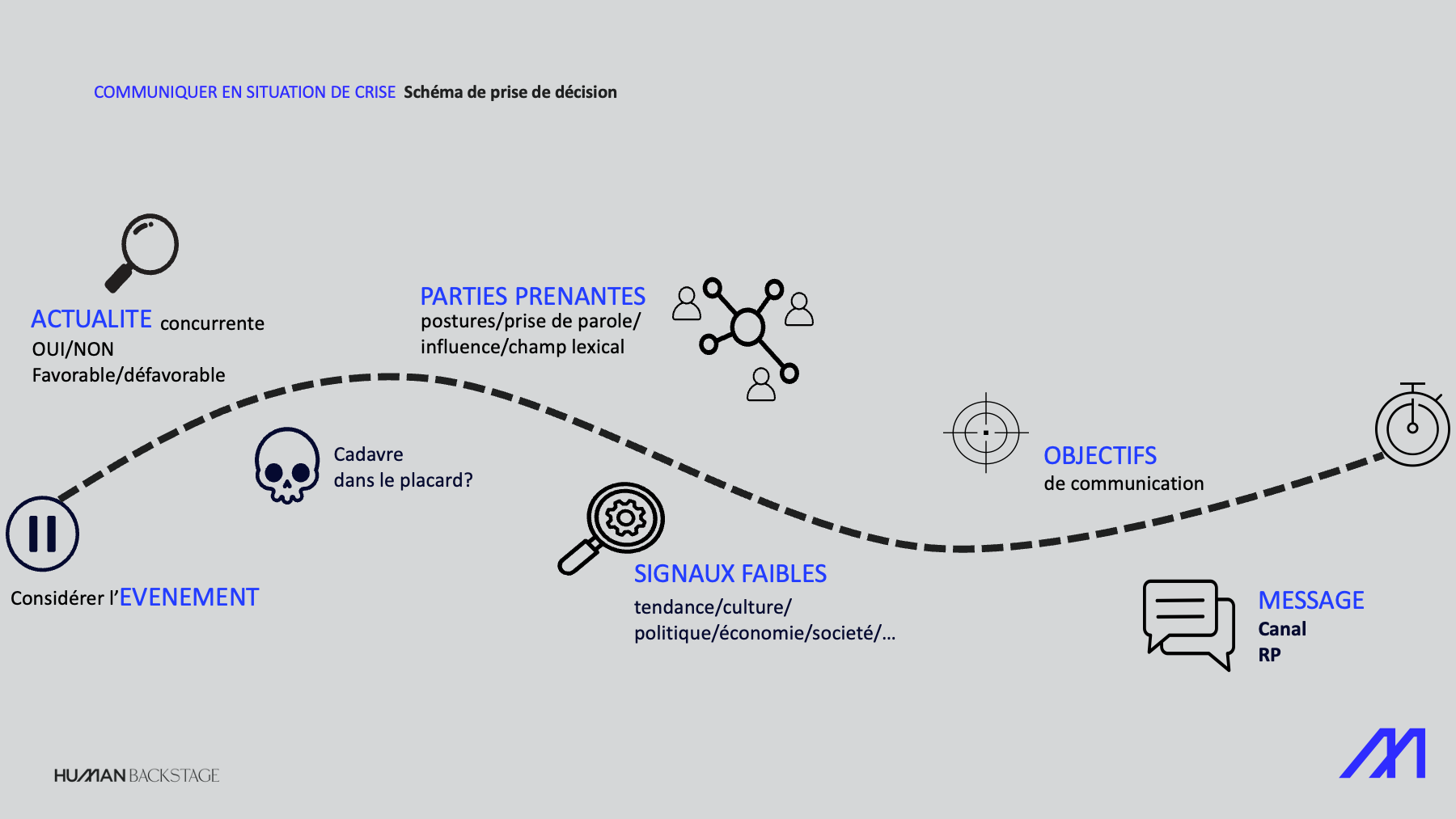
- Consider the protagonists and the emotions surrounding the event. This is, in a way, the "golden hour" of the crisis situation, the moment when you can allow yourself a little time before acting. So, take the time to analyze and remember that an overreaction is never beneficial.
- Quickly identify current events. What are the competing news stories? What topics are the media focusing on? This can have a strong impact, for or against, on the media coverage of the situation.
- Ask yourself this essential question: is there a skeleton in the closet? A crisis is always an opportunity to dredge up old skeletons. Even if they have no direct connection to the events you are managing, anticipate potential attacks that could be launched against you.
- Identify the stakeholders, both the ambassadors and the opponentsWhat are their stances? Have they spoken publicly before? Are they influential? What vocabulary do they use? Be vigilant against misappropriation: of your name, your logo, your slogan…
- Identify the weak signals from your stakeholdersTrends, culture, politics, environment… Everything can have consequences in a crisis situation.
- Define clear communication objectives : the message, the words chosen, the timing…
- Finally Broadcast this message, at the right time, on the right channel, in the presence of the right media. Give strength and efficiency to your COM devices.
5 – How to combine internal communication, press relations and digital communication?
Contributors, readers, internet users… It's important to know that everyone reads the same story. Therefore, messages must be consistent and updated in real time across the numerous communication channels.
Corn (Mais) The absolute priority is internal communication. Before communicating with a wider audience, it is essential to test your communication internally and to gather feedback from your colleagues. These are not simply employees, but engaged citizens, parents, politically active individuals, and so on. On the one hand, The internal system allows you to test and adjust intelligently. On the other hand, by involving him, You are showing appreciation, an appreciation that can prove very useful in sensitive times.
In terms of press relations, consistency of messaging is paramount. However, you can target the media outlets in which you communicate. In a world where journalists serve not only media interests, but also the interests of a media group, extreme caution is necessary. while never blacklisting anyone, because any situation can change.
Finally, On social media, the key words are embodiment and responsiveness. These channels are powerful vectors of emotion; we must combine them and avoid over-rationalization.
Before communicating with another audience, it is essential to test your communication internally, to learn from the perceptions of your colleagues.
6 – In your opinion, is a mea culpa a good stance?
Yes, when we can! Even more than a mea culpa, it is the posture of recognition that must be adopted, if part of the responsibility can be attributed to the organization. Because everything eventually comes to light… If this isn't the case, it's necessary to redirect this responsibility by highlighting verifiable and verified facts, and by taking coherent actions (including legal action). In any event, the approach adopted must be fundamentally empathetic.
In any case, the stance adopted must be fundamentally empathetic.
7 – How to conduct crisis communication to exert influence?
A crisis is fierce. However, Once the initial shock has passed, one must think about the opportunity. Indeed, it is always possible to turning a contradiction into an opportunity, a detractor turned ambassador.
Moreover, Co-creating with detractors can be very interesting; they do not ask the same questions, they challenge in a different way. Involving the opposing side potentially brings about a convergence of interests that truly strengthens actions and communications.
🎥 The workshop replay and the workshop presentation materials