

Producing ever more content… for an impact that is sometimes increasingly weak. This is the paradox that communicators face today. In a context where 91% organizations have increased their volume of editorial production in recent yearsThe question is no longer so much “how to produce?” as “why produce?”… and above all “with what impact?”.
Because the observation is undeniable: Accumulation does not equal performancee. Producing content haphazardly, multiplying formats without a guiding principle, treating each subject in isolation… these are all reflexes that dilute the messages and weaken overall coherence. The result: content that comes and goes... and disappears just as quickly.
 This is precisely what the We Are COM Club workshop sought to deconstruct. AlongsideAurélie Renard, expert and trainer at We Are COMThe discussions allowed us to return to the essentials: effective publishing is not based on volume, but on the intentionContent only truly exists if it fulfills a clear promise, if it is part of a strategy structured and if he brings a tangible value to its audience.
In the age of AI, this requirement becomes even more strategic. Because while the tools allow us to accelerate production, They do not replace framing, angle, or the ability to make choices.On the contrary: they reinforce the need to think before writing, to prioritize, to filter, to embody.
Aurélie Renard: Production tools are becoming increasingly powerful, and brands are producing content faster and faster. In this age of content saturation, we feel encouraged to publish more, while our impact diminishes. This may be the greatest paradox of communication!
The question is no longer how to produce content, but how to produce impactful content. 👉 An 8-point method!
#1 – What if the problem wasn't the lack of content… but its accumulation?
The observation? Most often, communicators produce content on an ad-hoc basis: new information generates a new publication. Individually, each of these pieces of content is legitimate and of good quality. The problem is that collectively and sequentially, they don't build impact. Ultimately, without a strong overarching theme, nothing sticks in the minds of readers.
The solution ? Narrow down the topics, define 5 or 6 main editorial directions. It's by focusing solely on subjects related to these limited themes that something relevant can be built. In return, you must accept not covering certain topics and make choices to avoid betraying your priorities.
#2 – Why is most content forgotten in seconds?
The observation? Too much content is still purely descriptive. A communicator isn't a journalist; their role isn't to simply transmit information, facts, or news, but rather to offer a genuine perspective. In other words, content focused on its sender, rather than its reader, is devoid of any real promise.
The solution ? Always place the target audience at the heart of your strategy. Ask yourself how your contribution can interest them and meet their needs and expectations. Editorial content is a tool that does nothing more than create a connection. And to create this connection with the reader, you must present them with the benefits, even indirect ones, they can derive from your contribution.
🤖 AI Tip: Make artificial intelligence your “brainstorming buddy” by using it to refine your titles, subject lines, and hooks. It will never replace writing itself, but it can help you gain impact.
#3 – Has producing quickly become the enemy of good content?
The observation? AI allows for faster production, but speed isn't necessarily the key. Often, producing quickly means producing less effectively. In the daily work of communications professionals, the constant need for responsiveness often prevents them from taking the necessary step back and framing their work to produce effectively.
The solution ? The impact of content is determined very early on, well before the writing phase. The framing process involves answering the three key questions of communication: Why? For whom? For what effect? It is essential to formalize the objectives and expected results before producing any content. This framing process saves both time and maximizes impact.
#4 – How to stop producing by reflex?
The observation? We still produce too much out of habit! This isn't a criticism, simply an observation, because service is part of a communicator's DNA: they respond to various requests. However, not all topics deserve your attention.
The solution ? You can't agree to every request, so don't try. Agree to produce content only if it aligns with your editorial strategy.
For each request, ask yourself if the topic is relevant to your target audience, if it's a priority, or if it sets you apart. Differentiation is crucial; a well-handled topic is one that adds value, and whose angle and usefulness support the brand strategy.
#5 – Does good content really start with the writing… Or with the angle?
The observation? Once again, it all comes down to what's planned. Good content always starts with a good angle. The angle is the perspective you bring, a perspective that sheds light on the subject matter. Ultimately, it's what transforms simple information into real content.
The solution ? To frame a topic, three approaches can be explored: impact, feedback, and behind-the-scenes insights. In other words, what the content can offer in terms of understanding, communication, and immersion. The choice of angle is truly crucial, since it is precisely this communication intention that will give a topic its appeal and depth.
🤖 AI Tip: Leverage artificial intelligence, but use a role-playing approach. Instead of simply asking it to find an angle for your content, put it in the shoes of your target audience. This way, the AI will suggest the most relevant angles for your content: lifestyle, expectations, pain points, habits, information consumption patterns, and more.
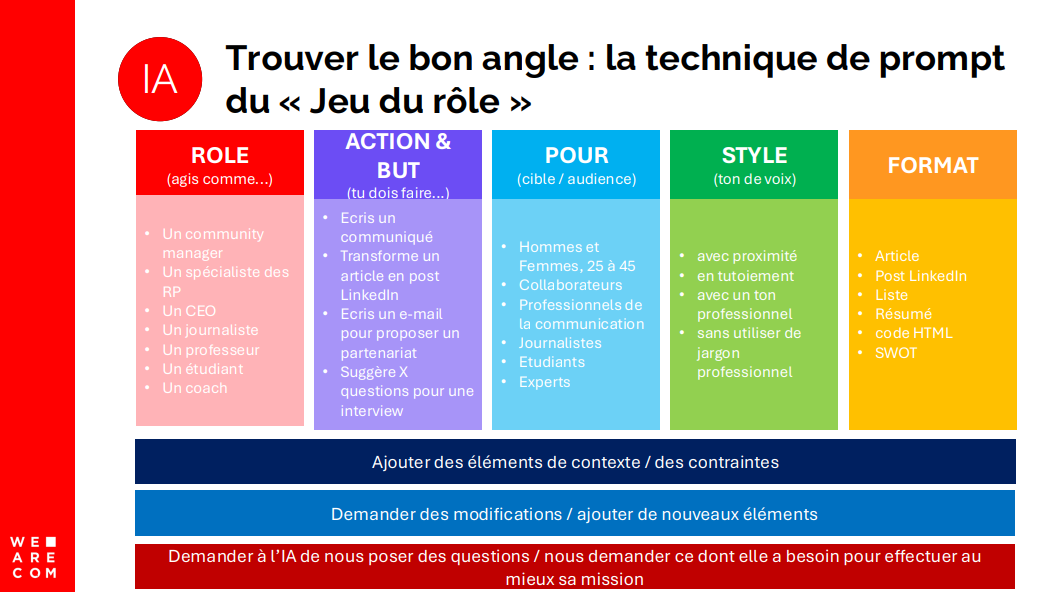
Here are two examples of prompts following this technique:
- "You are a journalist at [MEDIA], specializing in [THEME]. You have to interview [PERSON] for [TOPIC]. Suggest 3 angles for this topic which will be broadcast on [MEDIA] (whose readership is [TYPOLOGY])."
- "You are [PERSON: socioeconomic status, lifestyle, irritants, expectations, habits, etc.] and you are looking for information on [TOPIC]. What angles of communication would interest you most if [COMPANY] were to cover this topic? And why?"
#6 – Do you have to be everywhere to be visible?
The observation? No, being everywhere doesn't work. And on social media, wanting to be everywhere can be a bottomless pit!
The key thing to understand is that the impact of your content depends primarily on your target audience's attention span and usage preferences, far more than on the number of channels you use. Therefore, trying to be everywhere simply risks a decline in quality by churning out recycled content without reworking or adapting it.
The solution ? Making choices means amplifying impact! Identify the 2 or 3 preferred channels for your target audience, so you can offer them content that aligns with their actual usage. Then, regularly survey these audiences and assess what works and what doesn't: informal feedback, focus groups, etc.
#7 – Will AI transform editorial production… Or simply accelerate it?
The observation? We are still at the very beginning of our AI learning process, even though the tools and uses are evolving extremely rapidly. Nevertheless, we can already state that delegating writing to artificial intelligence inevitably leads to a loss of value and a standardization of your output.
The solution ? Make AI your editorial assistant, an expert assistant in rewording and optimization.
🤖 AI Tip: There are many tools available, and it's often difficult to choose the right one. My advice? Always prioritize your internal AI, if you have one. Otherwise, you have to test!
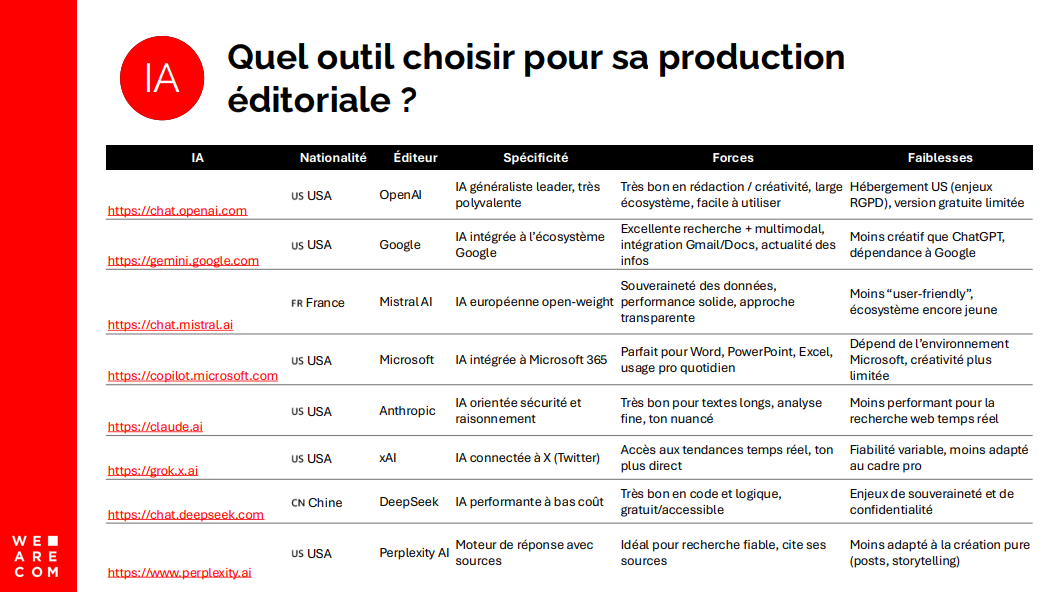
How to increase speed?
- Clarify your requests with agents: create AI agents capable of responding to your specific and recurring needs. While these small modules are not yet fully autonomous, they are very useful shortcuts for gaining speed and accuracy.
- Industrialize your recurring formats: design a library of ready-to-use prompts to save time without losing consistency.
- Accelerate the upstream phases: use AI to optimize your brainstorming sessions, your angles, your reformulations, your multi-channel variations…
How to become more original?
Differentiating yourself with AI is first and foremost about staying true to your brand voice. To write without betraying it, share your editorial guidelines with AI and provide it with content to analyze, such as your website. All you need is a URL and a well-structured prompt.
"You are starting a new job as a web writer (…). Before you begin, identify and formalize the writing style of this brand: tone, language level, content structure, lexical choices, differentiating factors, stance towards the reader…"
The next step is very simple: you just need to transform this analysis – more or less enhanced by you – into a prompt. This will allow you to write in your brand's style, without ever having to explain to your AI what tone to adopt.
#8 – In a world saturated with content, what still captures attention?
The observation? Unsurprisingly, in a world saturated with information, content that is too vague and too long does not work.
The solution ? To capture attention, content must be useful, clear, and relatable. It must provide added value to the reader and be easy to understand (avoid jargon), while also creating a connection. So be concrete, simplify, and humanize!
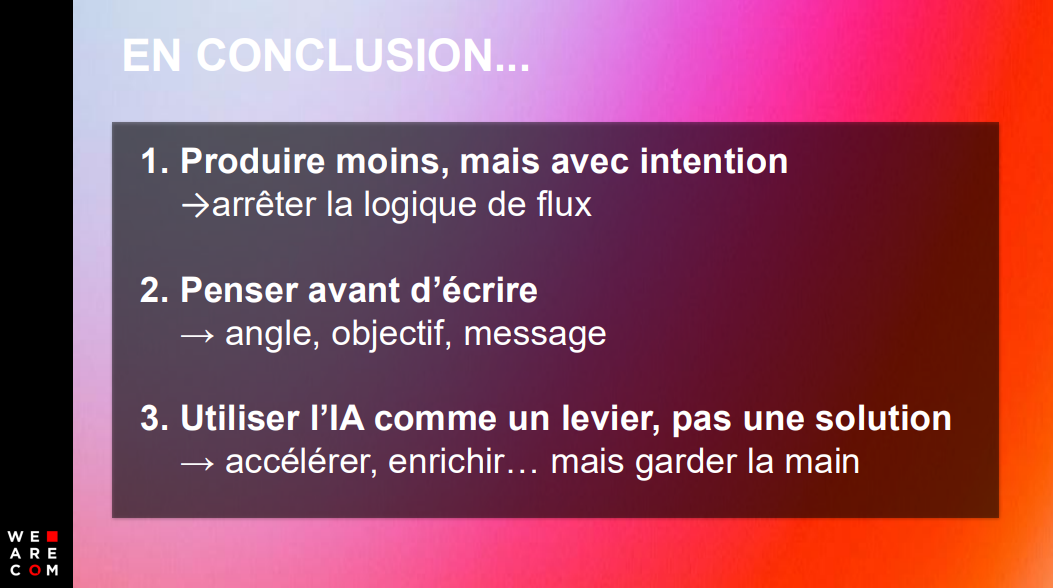
🎥 Replay and the spresentation support

🎓 To learn more…
What if you (finally) stopped producing in a rush and regained control of your editorial strategy?
The "Editorial Strategy" training course, led by Aurélie Renard, is designed as a true game-changer: a day to structure your content, clarify your priorities, and build a solid, coherent, and sustainable editorial line. The program includes concrete methods, actionable tools, and the intelligent integration of AI to increase efficiency without sacrificing your unique identity. A short format, but a long-term impact on your production process.
👉 Want to move from a flow-based approach to a real content strategy?