
When you type “digital sovereignty” into Google, you often end up more confused than before 😵💫 Politics, geopolitics, economics, European regulations: everything is interconnected. To get a clearer picture, the We Are COM Club received Jean-Philippe Balança, Chief International Operations Officer at Smile and an expert in digital autonomy and open source.
Twenty-five years in IT and digital, experience across Europe and the world, and a firm conviction: that of a Europe strong in its values and its independenceJean-Philippe assists both the French government and large private organizations in understanding their digital dependence. During a workshop, he agreed to lay everything out on the table, toFrom basic vocabulary to image-related issues that directly concern us, communicators. Interview 🎤
We talk about sovereignty and digital autonomy, sometimes in the same breath. What difference do you make between them?
The distinction is essential. sovereignty belongs to the StatesFollowing the model of energy sovereignty: in France, the State controls the entire chain, including EDF, RTE, nuclear power plants, and even prices.Digital autonomy, on the other hand, concerns organizationsCompanies or institutions that want to regain control over their tools without aiming for total independence. To understand where the dependence lies, you have to see an information system as a stack of layers: the visible application at the top, the invisible middleware in the middle, and the physical infrastructure at the bottom, servers and data centers. Becoming autonomous means being autonomous at each of these layers. But there's no need to aim for 100% autonomy everywhere: a simple video call doesn't require the same level of care as health data. There are many colors in the rainbow!
Why has this issue suddenly become so pressing for organizations?
Because of examples that leave a lasting impression. In 2025, two prosecutors at the International Criminal Court had their services cut off overnight by the American administration: no more Microsoft, no more Visa, no more Mastercard. A return to the Stone Age.
The mechanism is extraterritorial laws of the United States If your data is hosted by an American provider like Azure, the government can demand access, and the publisher must comply. The legal director of Microsoft France even acknowledged this before a parliamentary committee. To put all this into perspective, we now have... the digital resilience indexSupported by the Caisse des dépôts, the Digital Directorate and Docaposte. A framework that measures, layer by layer, your level of dependence and your resilience to shock.
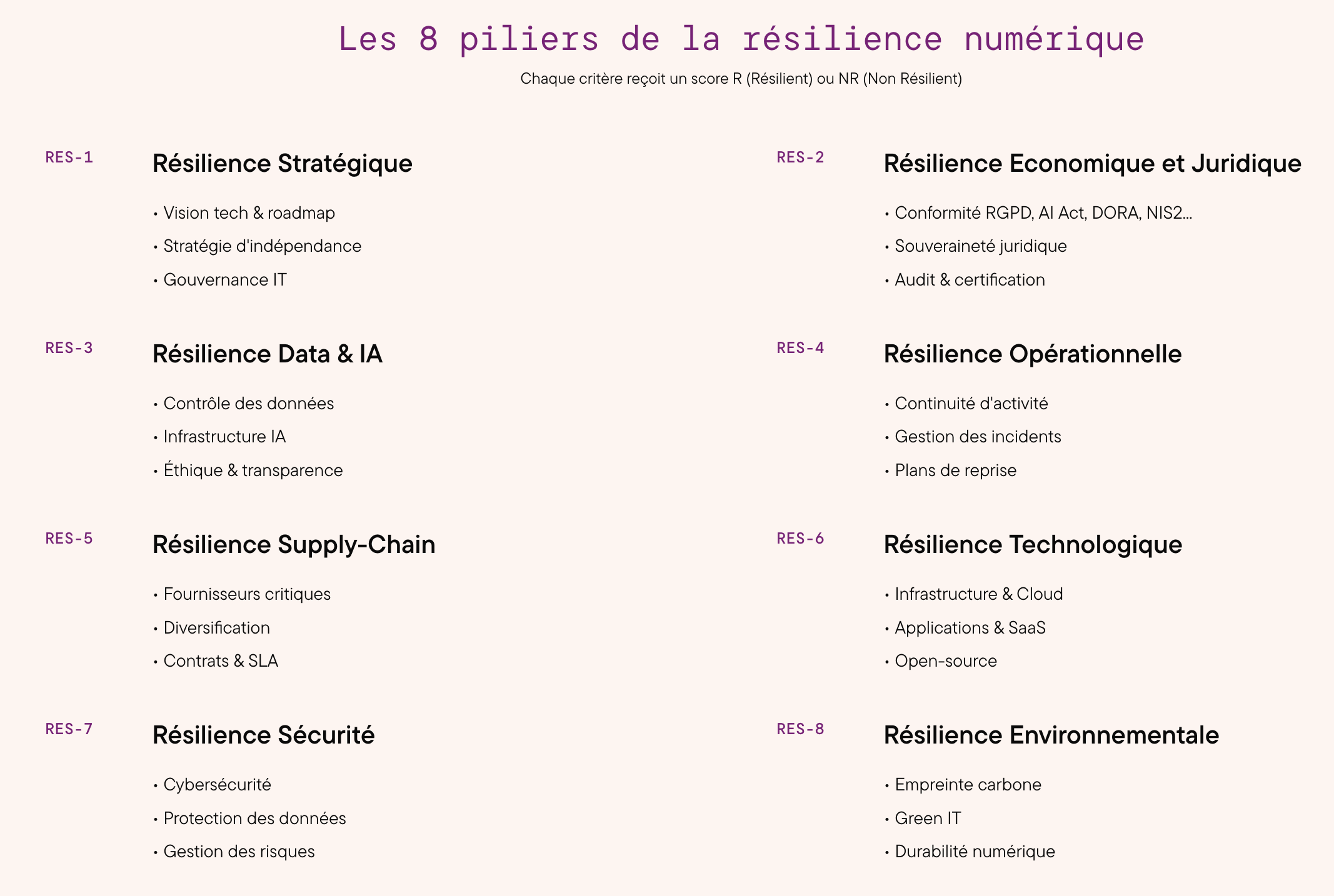
"Once you've measured your addiction, it's much easier to know what you can do and what you're going to do."
To what extent are we actually dependent?
The figure is stark: 85% of our cloud and software relies on non-European solutions.Not 30%, 85%. On the spending side, European organizations send €264 billion annually to non-European entities, primarily the GAFAM companies (Google, Apple, Facebook, Amazon, Microsoft), a figure taken from the Draghi report and the Cigref (French Interministerial Committee for Research and Training in Economics), which is increasing by 5 to 10% per year. I like to compare it to McDonald's: we've been going there for twenty years because it's convenient, it smells good, and the kids love it. Going to the market and cooking for yourself is more demanding, but it's still better. And the stakes are enormous: reducing our dependence by 10% each year would mean €26 billion injected back into the European economy and nearly 250,000 jobs.
"We've been funding innovation from American giants for twenty years. It's normal that our alternatives are a little behind. But often, we don't really have a choice anymore."
Are there any examples that prove the switchover is possible?
Many, and of considerable size. The French state began its recovery long ago with its own Digital suiteThe National Gendarmerie, with its 86,000 personnel, operates at 100% on open source solutions for the past eight years, quietly. In Germany, the state of Schleswig-Holstein It has weaned 55,000 Microsoft and AWS employees off the grid in five years. To replace Amazon Web Services, there's OVH or Outscale.
Et Open source is our best asset Today, nearly 85% of servers worldwide run on Linux. A sign that things are changing, at Smile we now receive four to five requests per week from large organizations. That was unimaginable yesterday.
"Open source is one of our fundamental strengths for replacing non-European systems. We are very strong in this area, both in France and in Germany."
Why this collective awakening now?
Three turning points. The "America First" policy initiated under Obama fifteen years ago, with the American refocusing on the Pacific. The war in Ukraine, which reminds us that there are predators at our borders. And the rise of digital predators, models analyzed in detail in the book. The predators' hour by Giulliano Da Empoli, former advisor to Mario Draghi. On the institutional side, the European Commission has just published its technological sovereignty package, with a clear doctrine: open source first et Buy European if you canA semantic change that is far from insignificant.
Why is this a topic relevant to communications professionals?
Because it's poorly managed, the digital choice becomes a reputational disaster. In Geneva, in June 2025, the canton announced it would expand its Microsoft services: a media outcry, a federal audit imposed, the decision suspended, and a disastrous image. The same thing happened at Polytechnique in the spring of 2025, where the Microsoft hosting project cost two directors their jobs. My point isn't that we should switch everything over tomorrow, but that we absolutely must not ignore the subjectAnd there's a bright side: promoting digitally responsible, and therefore civic-minded, choices that respect data and fund European innovation is becoming a real brand advantage. Knowing where your data is even becoming a selling point, in banking as well as insurance.
💡 The We Are COM advice: If you value your digital choices, make them auditable. Rely on a framework like IREN and provide concrete evidence. Jean-Philippe speaks of “proof of love”: demonstrating that you've truly made the switch is worth a thousand declarations of intent. And remain vigilant against whitewashing: after greenwashing, openwashing and sovereignty washing are flourishing. When AWS or Azure announce a “sovereign cloud,” lift the hood; you'll find proprietary components.
Is AI changing the game, for better or for worse?
For the better, if we act now. The dependency plays out on even more layers: energy, chipsets (none of which are manufactured in Europe), data centers, models, applications. But the good news is thatWith AI, we are not yet dependent.Therefore, now is the right time to choose European, relying on European data centers and open models, whose algorithms and weights are known, such as those of MistralEDF, Veolia, and the Ministry of Defense are already doing it. And the issue goes beyond technology: AI carries cultural and value biases inherited from its training data. Adapting our practices to non-European models means importing a framework that isn't our own. It's almost a systemic risk.
"Our AI models should be fed with European data, faithful to our culture, our relationship to democracy and freedoms."
What message do you have for communications professionals?
To choose is to renounce, and choosing your digital tools today is an act of responsibility. I myself, on my new PC, traded in Word and Excel for only OfficeA little less fun, but it works very well. We were fleeced, we followed the leader like sheep. We have to raise our heads, for ourselves, for our children, for our organizations. Neither naivety nor dogma: just pragmatism and a five- or ten-year vision.
And you ? Have you ever questioned your own digital choices, and would you be willing to make them a deliberate communication message?
🎥 Replay of the “Digital Sovereignty” workshop and spresentation support