

How do we play with words? What are their meanings, signifiers, connotations? Is the intention of the sender of a message invariably the one that the receiver will perceive? You know very well that it isn't! So, to communicate effectively, let's examine the brain mechanisms that allow two entities to reach an understanding, ideally a shared one, or at least an "optimized" one. ????
🚀 We had the pleasure of hosting a workshop from Club We Are COM an expert in the field: Elodie MielczareckA passionate and engaging semiologist, specializing in language and body language, she advises and trains business leaders and supports... communication strategies Semiological audit, strategic planning, brand value definition: she also appears on TV to provide semiological analysis of current events. Let's not miss out on this masterful expertise in this episode #1.
Want to know how to put semiotics into practice? Discover Episode #2 for top tipsLet the magic begin! 🔮
Hello Elodie! First of all, do you think that communication results from a fluid human process?
We are far too often trapped in the idea that communication is innate and fluid. Indeed, we master its codes from a very young age. And this is true long before we have the use of our native language, since communication is far from being purely verbal.
However, when we delve deeper, this question proves to be far more complex. We must begin by dispelling a number of myths…
There's a universal fantasy: to think of communication as a given. Many consider it fluid and direct. However, communication is more unpredictable than we think. We are not TVPathes: imagining communication without "accidents" or "breaks in meaning" is therefore a utopia. Let us reassure ourselves: the richness of language stems precisely from this depth between thought and words.
Ambiguities, misinterpretations, and failed semantic effects are legion in communication, much to the delight of semiologists! The value of semiological analysis lies in the keen eye it casts on the "margins" of communication. : everything that happens in the cracks and in the corners. Unlike the communicator who deals more with what happens on the stage, the semiologist shines a spotlight on what goes on behind the scenes.
Between what I think, what I want to say, what I believe I'm saying, what I actually say, what you want to hear, what you truly hear, what you think you understand, what you want to understand, and what you actually understand, there are at least nine possibilities for misunderstanding..
Bernard Weber
The renowned author outlines nine possible ways in which semantic deviation can occur. There are even more. This is why I like to talk about the "magic" present in the process of understanding. The magic of communication is believing that we always understand each other, and succeeding in doing so, in a certain way.
More specifically, we must deal with areas of interference between a sent message and a received message. The intended meaning is the one encoded by the sender; the received meaning is the one that arrives at the destination after decoding by the receiver. Encoding and decoding constitute these areas of interference. The semiologist, for his part, is interested in the real meaning emitted (which will be neither that of the start, nor that of the arrival).
In semiotics, we focus primarily on the actual values conveyed, that is, on the intermediate phase of understanding. The intentions of the sender and the psychology of the receiver are initially disregarded. Our discipline is situated, in a way, on the margins of communication, in the interstices where all sorts of misinterpretations can occur. Indeed, the semiologist is more interested in signs and the effects produced than in intentions and desiredof the transmitter.
Does this "magic of communication" still work in times of crisis?
Let's not be mistaken: communication doesn't depend solely on written, read, or heard words. The magic mentioned earlier isn't linked to dictionary language, but to a profound and powerful alchemy that takes place between speakers. Because "effective" communication aligns relevance between what is said and unsaid, what is present and what is absent, and what is material and conceptual.…And this alignment is “magical”, in the sense not fully explainable.
How do you and I understand each other? Not just because we share a language and a common culture. Far from it… We understand each other because we have access to each other's intentions. In other words, a large part of communication is determined by the context and its practices, but above all by an understanding of everything that is implicit, presupposed, and unspoken. Everything that is intangible and beyond the sign is part of communication.
Moreover, the COVID pandemic is there to remind us of this: Informing is not the same as communicating.The digitalization of our exchanges clearly shows us that the transmission of information is not "enough" to make communityFor example, the Kruger&Co experiment (2005) demonstrates that the "sarcastic" nature of an email is identified only about half the time (56%). That's very little!
Le digital It is very efficient for transmitting data (information), much less so for conveying intentions and emotions (communication).Communication takes many forms, and not all of them are channeled digitally. Here are the main consequences:
- Overall, the paraverbal related to the voice (intonation, pace, pause, etc.) is rather well transcribed when the technique allows it.
- > The infraverbal linked to physiological changes (pupil dilation, blushing, pheromones, etc.), and which informs us – unconsciously – about the state of the relationship, is completely absent.
- > The kinesicThis, combined with body movements and facial expressions, is more noticeable when your interlocutors turn on their cameras. The only problem is that we're talking to men and women who are essentially "torsos," as only the upper part of their bodies is visible.
So, a whole aspect of communication is escaping us. One might even wonder if we are not unknowingly experiencing certain pathologies. such as prosopagnosia (difficulty recognizing faces), alexithmia (difficulty naming emotions), social phobia (the other is a virus carrier that I must avoid), or even emotional anesthesia (through the action of mirror neurons, if my brain perceives fewer of the emotions of my interlocutors because of wearing a mask, then I also feel fewer emotions…)
In your opinion, which parts of the brain are more sensitive to communication?
We are very influenced by completely automatic things over which we have no control, and we don't even know we're doing it. (...) No one would say, "I'm voting for this guy because he has the widest chin," but that's actually partly what's happening..
David Kahneman
The renowned psychologist and economist, also a Nobel laureate in 2002, has truly shaken things up with his work. He scientifically validates the fact that our decision-making is irrational. Indeed, the human brain is composed of two areas that are both antagonistic and complementary.
On one side is "System 1". Located in the limbic and reptilian brain regions, this represents our "animal" and instinctive brain. This system is based on the principles of speed, the unconscious, and automaticity. It accounts for 95% of our daily brain activity. That's enormous! This "autopilot" has its own language, sensitive to associations and devoid of negation. If I tell you: whatever you do, don't think about a pink elephant! What did you think of? He is the linguist George lakoff who has taken a great interest in these linguistic functions.
On the other side is "System 2". This latter part, less involved, accounts for 5% of our decision-making. It requires more effort and concentration, relying on the slower pace of reason and logic. It's your "conscious pilot," the one that takes the time to analyze. In short, the most rational part of your brain.
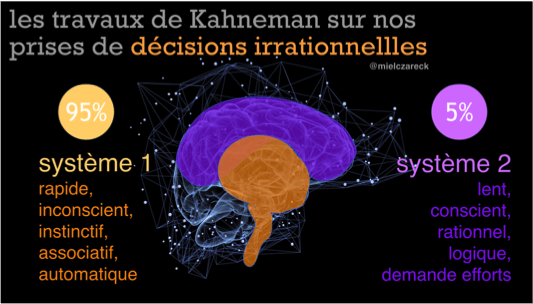
For other researchers, such as Antonio DamasioThese two systems form a whole: Reason and emotion are exactly the same thing, but not at the same time! And it is always your "emotional brain" that takes the lead, even if your "rational brain" puts the outlines of logic into it.
Ultimately, is understanding a message more conscious or unconscious?
To return to professional communication, that of brands and companies, the language you use in your advertising campaignsFor example, it is well-made and rational: it originates from your System 2. However, it will initially only be received by your targets' System 1. Ultimately, being a communicator means being a translator: being able to make logical information digestible (system 2), and transform it so that it is appreciated and selected (system 1).
That is why speaking the language of the unconscious matters. To handle it, manipulate it, and guide it represents, for many, the Holy Grail, and rightly so. Moreover, the neuroscientist Stanislas Dehaene has looked into this subject. We could summarize some of his remarks in two points, though not exhaustively:
- The unconscious mind retains several million pieces of information per second, versus our conscious mind which only retains a few dozen in the same amount of time.
- Symbolic representations, although they take some time to be deciphered by our conscious mind, are interpreted immediately by our unconscious mind.
Indeed, this unconscious is very sensitive to certain types of signs, such as symbols and archetypes. But also, as we will see in episode #2, to certain words: not all words are equivalent.
And how does our brain perceive reality? If reality even exists…
Our understanding of the world operates through various filters. First, there are sensory filters: our experience of reality is not the same as that of a fly, because our senses are not the same. We have five senses. But take the example of your dog or cat; their sense of smell is much more developed, and their perception of colors less nuanced. Our perceptions of reality are therefore quite different. Then there are cultural filters: language selects the aspects of reality that it deems relevant. Finally, there are personal filters, linked to our experiences. Ultimately, we never truly and directly have access to the world around us. This world is shaped by our senses, our experiences, and our beliefs.
And what is interesting to raise in the context of communication are the linguistic consequences of this relationship to the world. The word is a choice made in relation to reality, but does not constitute a reality in itself. Which leads to the saying Spinoza, to whom this sentence is attributed, that “the word dog does not bark".
What is reality? What is the definition of reality? If you want to talk about what you can touch, what you can taste, see and smell, then reality is only an electrical signal interpreted by your brain.
Matrix – Lana and Lilly Wachowski
Here we raise a debate that is thousands of years old in the philosophy of language: the relationship between the word and the thing. Two schools of thought clash on this issue:
- The Nominalists They claim that each object possesses its own unique essence. In other words, words are labels: changing the word does not change the thing.
- The constructivists, They, on the other hand, prefer to think that an object only exists and is constructed through the gaze of an observer. A word is not a label; we cannot change it without changing the object to which it refers.
Semiologists are constructivists. The falling of a tree that is neither seen nor heard does not constitute a reality. There are only points of view of reality, of which words are clues.
In conclusion, can you tell us what stance to adopt to help us, as communicators, to take a step back?
Words are becoming increasingly fluid. They shift according to points of view, constantly altering the realityel. Encountering their own etymological history, the symbolic weight that society places on them, and the psychological baggage of each speaker: words have an abyssal resonance.
Semiology sheds light on all of this. This discipline allows for conclusive analyses thanks to its unusual approach.
The semiologist is the one who sees meaning where others see things.
Umberto Eco, quoting Roland Barthes
Thus, semiology rests on four essential postulates:
- Reality is a human constructThe object only represents the result from one point of view. For you, as a communicator, ask yourself this question: What bias am I currently assuming?
- Nothing is ever obvious. Sometimes you have to learn to deconstruct everything in order for a body of work to make sense. To have the ingenuousness of a child, the gaze of wonder… And if I were an extraterrestrial, how would I perceive this communication medium? That's a good question to ask.
- The container is more interesting than the contents. We are more interested in the how than the why. For you communicators, this means asking yourselves about the invariants: where are they in your communication? Conversely, where can you innovate?
- The object is a system of relations. From a purely analytical and cold point of view, the semiologist establishes "rules of grammar". For you as a communicator, the question to ask yourself is that of relevance: how do the signs, combined together, form a coherence?
Language is a system of signs expressing ideas and, as such, comparable to writing, sign language, symbolic rites, forms of politeness, military signals, etc. It is simply the most important of these systems. We can therefore conceive of a science that studies the life of signs within social life; (…) we will call it semiology (…). It would teach us what signs consist of, what laws govern them.
Ferdinand de Saussure, father of semiology
Semiology: do you want more? Discover This workshop will continue with practical advice. on semiotics in your communication strategy!
BONUS – Are you a good semiologist?
Here's a mini quiz: test your knowledge of semiotics in 5 minutes! A great way to assess your foundational knowledge. Be warned, the results might surprise you… Are you daring enough to give it a try?

Elodie Mielczareck,
Passionate semiologist, body language specialist and strategic consultant for companies.
(I.e. Tdownload the presentation slides