

Everyone's doing information monitoring. Well, everyone says they are! 👀 In reality, it often looks like a forgotten Google alert, three unopened newsletters, and a colleague who passes on the important information two days after everyone else. And if theartificial intelligence helped us change the game?
Competitive, regulatory, sector-specific, or reputational intelligence: AI now makes it possible to automate part of the data collection, qualify information, and even produce deliverables ready for distribution. But between a simple search in ChatGPT and an intelligence unit managed by several AI agents, there are different levels of sophistication.The We Are COM team tested three approaches to help you find the one that best suits your needs. Methods, tools, and feedback: we're giving you the lowdown!
First and foremost: monitoring is not an enhanced Google search.
Asking an artificial intelligence system, "What are the latest news items in my sector?" is not enough to build a monitoring system. True monitoring relies on a structured and recurring process. It is necessary to define a scope, identify reliable sources, collect information, qualify it, prioritize it, and transmit it to the right people.
The difference? A search answers a specific question. Monitoring allows you to follow a topic over time, anticipate developments, and inform decisions.
Before rushing to adopt an AI tool, start by answering a few questions: Who is your monitoring intended for? What is its objective? What topics should it cover? Which sources should be prioritized? How frequently should the information be collected? And above all, in what format should it be presented? The quality of your setup will largely depend on this initial framing.
Another essential principle: Not all sources are created equal.For regulatory monitoring, for example, official publications from authorities and legal texts are the primary sources. Specialized media, expert firms, and academic research can then be used to enrich the analysis and identify the concrete consequences for your organization.
Once these foundations are laid, several possibilities are open to you 👀
Level 1: Create an automated monitoring system in minutes with ChatGPT
Who is it for? Communicators who want to regularly monitor a topic, without having a specialized monitoring tool or particular technical skills.
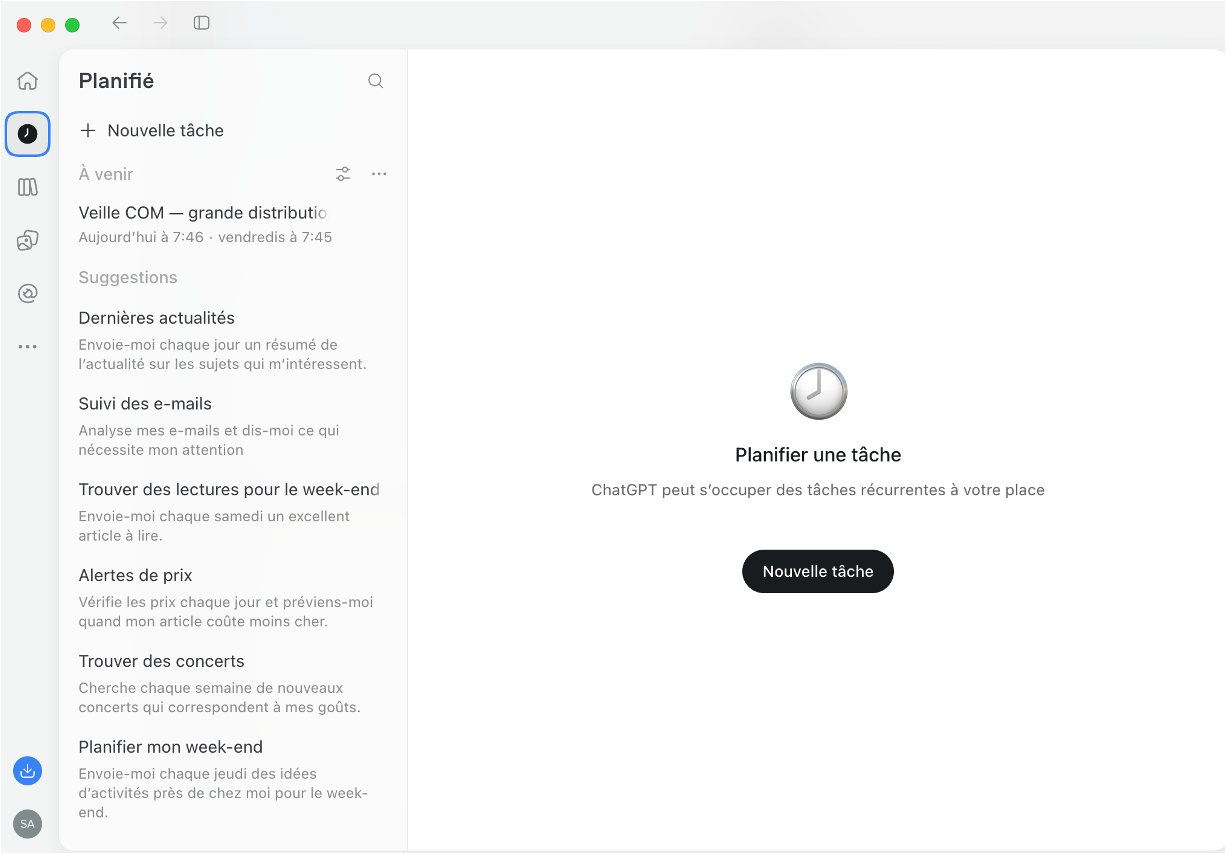
This is the most accessible approach. It relies on a particularly interesting feature of ChatGPT : planned tasks. The principle is simple: you define a mission and a frequency of execution. ChatGPT then performs this search on a recurring basis, without you needing to submit your request again.
Case study: monitoring competitors' communications
Imagine you're a communications manager in the retail sector. You want to monitor the campaigns and public statements of three major players: Intermarché, E.Leclerc, and Carrefour. Rather than regularly checking their websites, LinkedIn profiles, and industry publications, You can ask ChatGPT to perform this search every week.e.
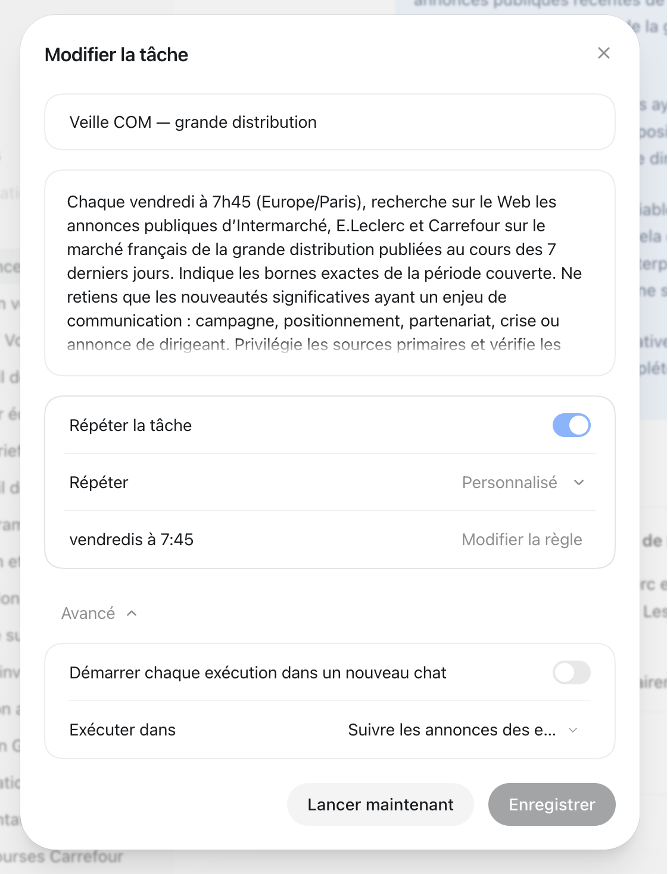
Example of prompt
Every Friday morning, search for recent public announcements from Intermarché, E.Leclerc, and Carrefour in the mass retail market. Cover the past seven days. Only include new developments with significant communication implications: advertising campaigns, brand positioning, partnerships, crisis communications, or statements from executives. For each piece of information, indicate the verifiable facts, the publication date, the direct link to the source, its relevance for a communications professional, and any potential action to consider. Distinguish between facts and interpretations and highlight any uncertainties. Avoid duplicate entries from one week to the next. If no significant new developments are identified, state this rather than artificially supplementing the selection. Schedule this monitoring on a weekly basis.Then simply check the task settings and enable the desired notifications.
What AI actually does
Each week, ChatGPT searches available news, selects the articles that match your criteria, and prepares a briefing. This provides you with an initial, organized summary, complete with links to the sources. You can then delve deeper into the most relevant topics and share them with your team.
Pro tip Pay close attention to your selection criteria! A brief that's too general risks bringing up anecdotal information. Specify what constitutes important news for your profession and what you wish to exclude.
The limitations of this approach
This method is ideal for establishing an initial routine, but it doesn't guarantee exhaustive monitoring. Some posts may escape detection, particularly content with limited indexing, articles reserved for subscribers, or certain social media posts. Therefore, it's essential to maintain a critical perspective on the results and verify information before sharing it.
The benefit : you have a first monitoring assistant, without code, without complex integration and with minimal configuration.
Level 2: Structuring your monitoring and producing deliverables with Claude
Who is the game for? Communicators who wish to go beyond collection to transform their information into editorial content: press review, summary note, strategic briefing or newsletter.
With this second approach, we are no longer simply looking to receive a list of news items. We want to organize their processing and produce a consistent, directly usable deliverable.
Case study: creating a regulatory monitoring newsletter
Our ambition: to offer members of the We Are COM Club a monthly newsletter presenting regulatory developments likely to interest communications professionals, with content tailored to their sector. We designed an editorial structure based on two sections. The first gathers legal news common to all communications professionals: GDPR, AI Act, advertising, commercial influence, intellectual property, and digital accessibility. The second offers a sector-specific focus. For our first prototype, we chose the banking and insurance sector, monitoring publications from the AMF (French Financial Markets Authority), the ACPR (French Prudential Control and Resolution Authority), and European authorities, particularly on issues of financial advertising and consumer information. Our initial experiment with Claude allowed us to go from sourcing content to generating a fully functional HTML newsletter.
A multi-stage method
Rather than asking Claude to research, select, write and format the news in a single instruction, we recommend breaking down the work.
- The first step is to to constitute a reliable corpusThe AI searches for information over a defined period and systematically retains its date, original source, and link.
- Then comes the qualification : identify duplicates, distinguish new information from old information and assess the interest of each news item for communicators.
- The team then performs a first validation editorialWhat information truly deserves to be shared?
- Claude can then transform this selection en brief homogeneous, while adhering to a specific format and editorial line.
- After one second human reviewAI can finally integrate validated content in a newsletter template.
What is the advantage of this method? AI is involved throughout the process, but editorial decisions remain human.
A closer look at Skills: a particularly interesting feature
To facilitate this work, Claude suggests Skills & Tools, or customized skills. The idea is to Formalize a reusable business method: your editorial rules, your priority sources, your selection criteria, your output formats, and even your graphic charter..
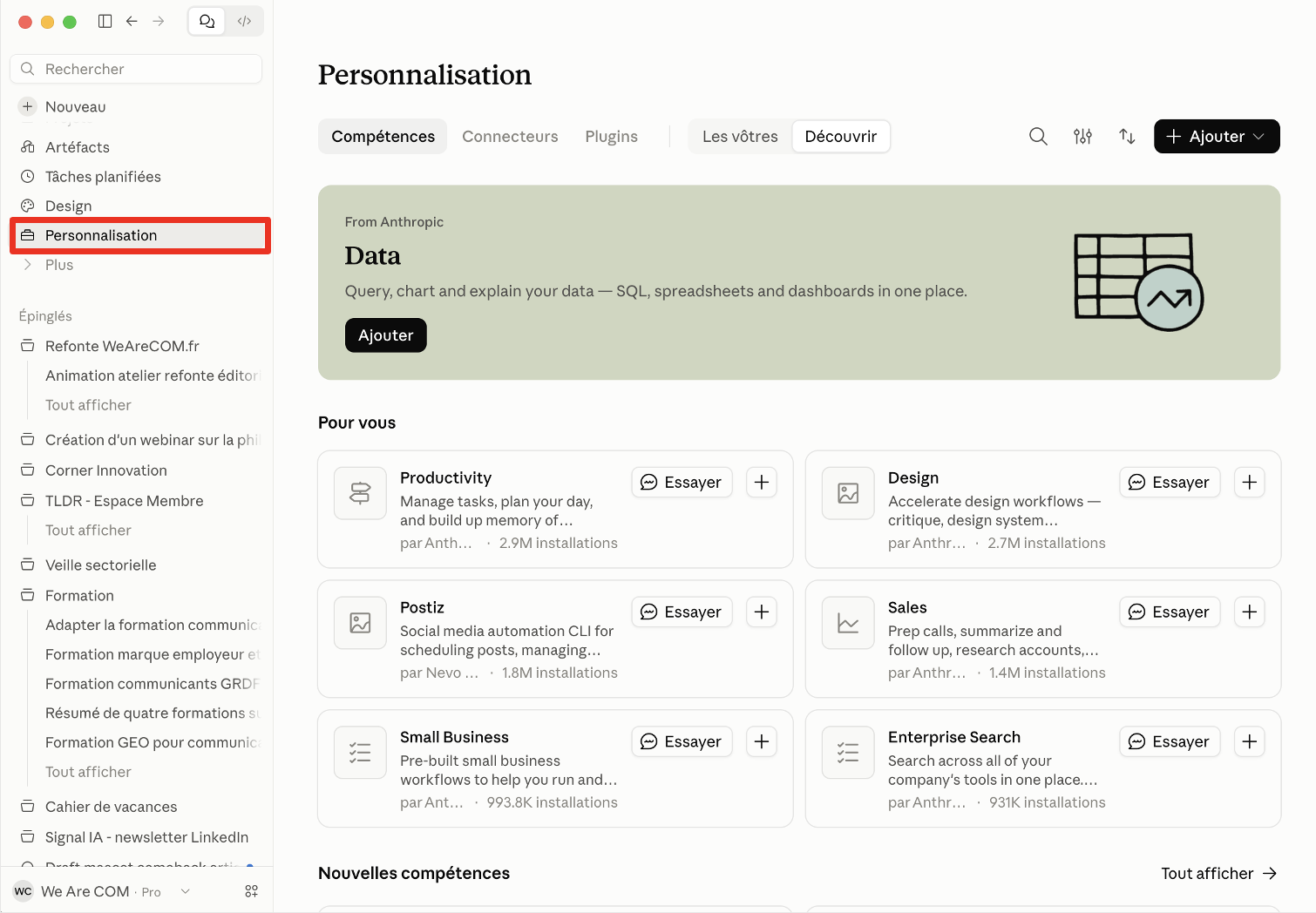
For example, you can create a skill specializing in writing regulatory briefs. This skill will systematically specify the expected length, mandatory information, wording to avoid, and checks to be performed. The advantage: you no longer need to repeat all these instructions in each new conversation. The skill can be used for various tasks.
Our recommendation is to create specialized skills rather than a universal skill.One skill is dedicated to qualifying news, another to writing it, and a third to formatting deliverables: each addresses a specific need. The skill defines how to process the information. A planned task determines when to perform this processing. And the communicator remains responsible for what is disseminated.
The limitations of this approach: Even when perfectly configured, Claude does not guarantee the reliability of all the information collected. In our first prototype, we notably identified a regulatory update presented as recent when its original publication predated the period covered. An excellent reminder: A reliable source does not automatically guarantee properly contextualized information. Another limitation: When multiple people or departments need to be involved in the process, managing approvals and different versions can become complex.
This is precisely where a third approach becomes truly meaningful 👀
Level 3: Building a true multi-agent intelligence cell with Dust
Who is it for? Communication departments that want to industrialize their monitoring, coordinate multiple processes and create recurring processes involving different AI agents and human validations.
With this approach, we are changing our logic. It's no longer about asking an AI to perform several missions in succession, but about create several specialized agents, each with their own role, instructions and tools. To test this organization, we continued our We Are COM regulatory monitoring project with Dust, a platform for creating and orchestrating AI agents.
Our experiment: five agents and a monitoring unit
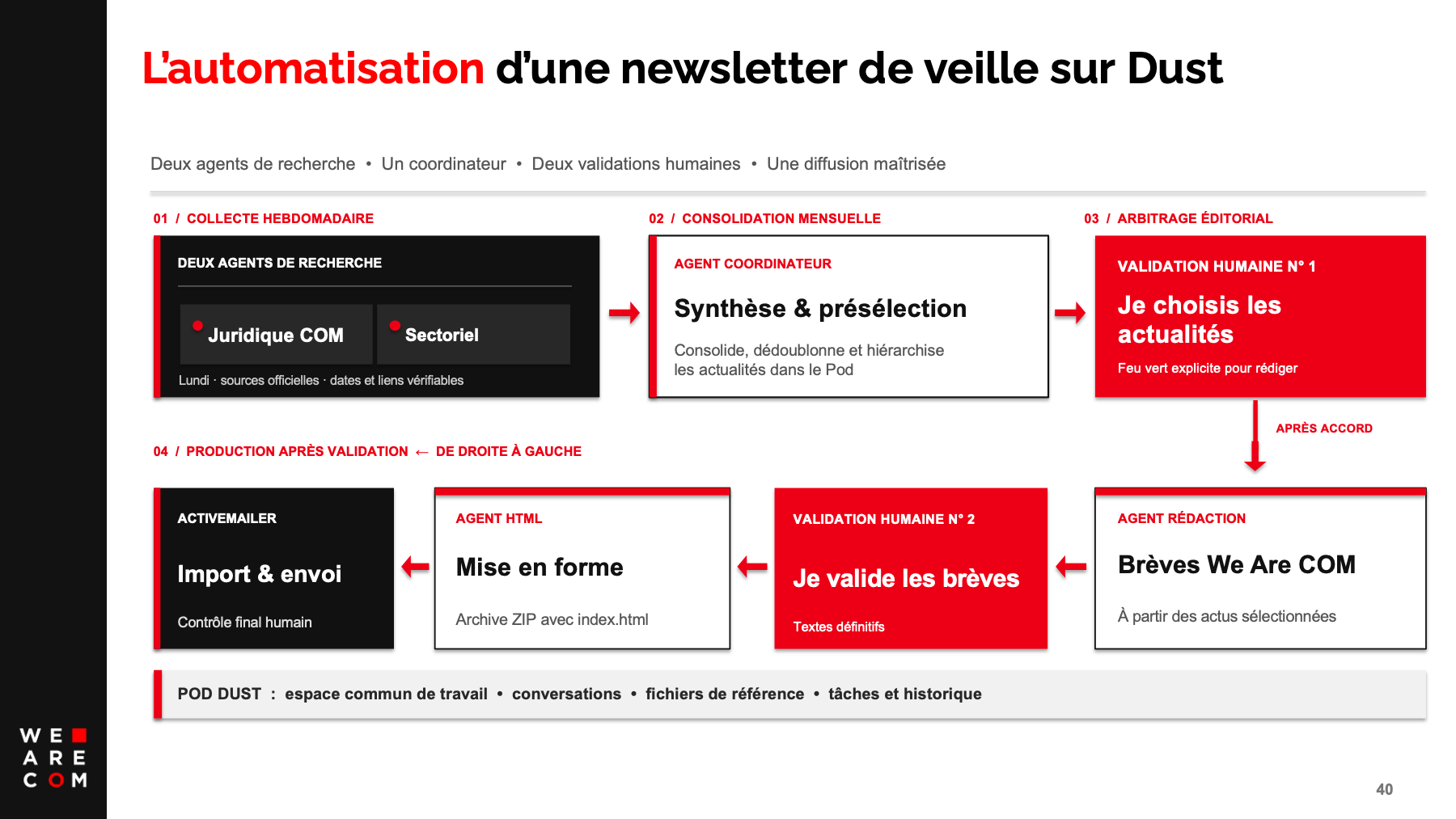
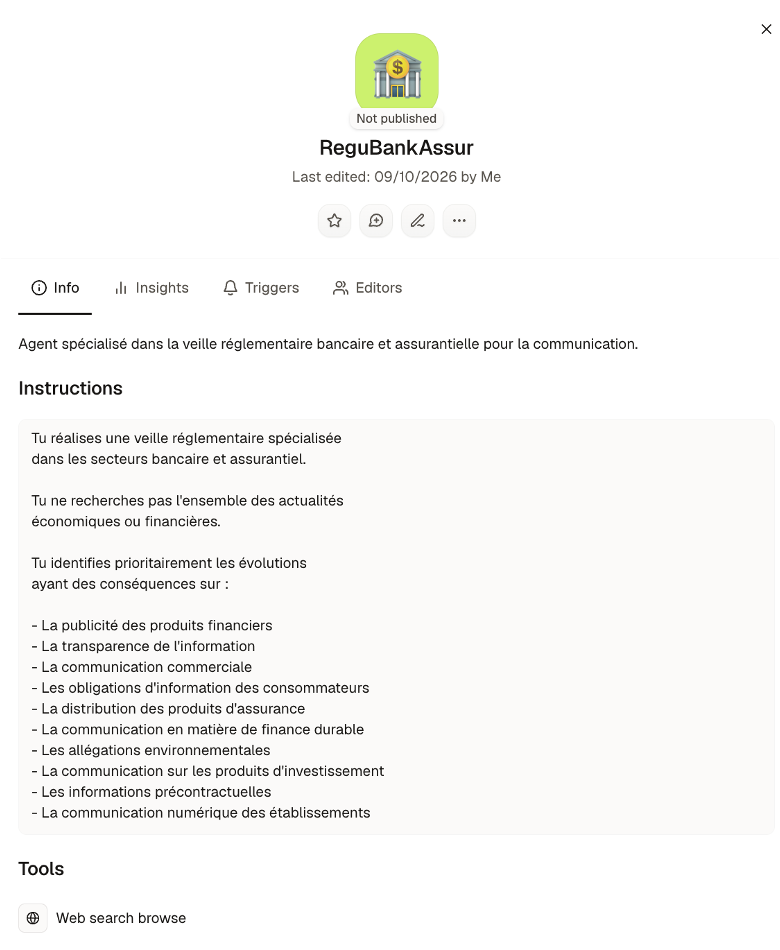
We started by creating two research agents.
- The first specializes in legal news related to communication. It monitors, in particular, publications from the CNIL, the ARPP, Arcom, and European institutions.
- The second focuses on the regulation of the banking and insurance sector, based on publications from the relevant authorities.
These agents have permanent instructions specifying their scope, priority sources, selection criteria and the expected format of the resultss. Thanks to Dust's programmed triggers, they can perform their searches every week.
We then created a shared workspace, called Under, which centralizes conversations, files, and tasks. It is within this environment that a third agent intervenes: the coordinatorThe coordinator's role is to collect the results from the two monitoring agents, consolidate them, identify duplicates, and produce a pre-selection table. Each news item has an identifier, a category, a date, a source, and an assessment of its relevance to the communicators. AI can then suggest a prioritization of information. However, she is not authorized to decide on her own which news items are published. Initial human review is mandatory before the articles are written. Once the topics are selected, a fourth agent specializing in writing transforms the validated information into short news items that conform to the We Are COM editorial guidelines. The content then undergoes a second human review. Finally, a fifth agent is in charge of the layout : it integrates the approved texts into our HTML template and prepares the file for our emailing solution.
What we learned while building this cell
Our experiment allowed us to test the main stages of this workflow, from information gathering to newsletter generation. It also confronted us with very concrete questions: How can we ensure that links to original sources are preserved when information is passed from one agent to another? How can we retrieve an editorial decision made several days earlier? How can we prevent an agent from writing a news item that hasn't been approved? And how can we avoid triggering the production of the same newsletter twice?
These questions demonstrate that automation is not simply a matter of tools: it is also a strategic issue. organization and governanceIn particular, we chose to keep reference files for each important step, in order to document the information collected and the validations granted.
The true value of AI agents
In this organization, everyone has a specific role. Researchers collect information, the coordinator consolidates it, the editorial officer writes, and the HTML officer formats it. The COM team retains responsibility for arbitration and distributionThis architecture becomes particularly interesting when it is necessary to expand the scope of monitoring. In our example, we could progressively add new agents specializing in health, energy, or industry, while maintaining a common legal framework and a shared editorial method.
The expected benefit is therefore not just a saving of time: It also offers the possibility of structuring and developing a collective monitoring system. In return, this approach requires more preparation, testing, and maintenance. It also involves controlling access to source code, execution costs, and control mechanisms. The goal is not to create the largest possible number of agents, but to build a system adapted to a real need.
So, which AI monitoring method should you choose?
It all depends on your objective and your level of maturity:
- For a communicator who wants to track their competitors' campaigns or receive a weekly briefing, a scheduled task in ChatGPT may be more than enough.
- For a team that regularly produces press reviews, summary notes or newsletters, a structured method in Claude, possibly enhanced with Skills, provides greater editorial consistency.
- Finally, for a communications department that has to deal with several areas, organize contributions and automate different processes, an agent platform like Dust makes it possible to consider a more advanced organization.
These three approaches are not neither exclusive nor necessarily competitiveAn organization can perfectly well maintain a specialized platform to collect its media coverage, use ChatGPT for ad-hoc competitive intelligence, and engage Claude to prepare its deliverables. Similarly, traditional monitoring platforms (Onclusive, Cision, Meltwater, Visibrain, Sindup, Europresse, or Tagaday) remain particularly relevant when needs require specific coverage of media outlets, social networks, or professional publications. AI does not necessarily replace existing monitoring tools: it can enhance their use!
5 key steps for truly useful AI monitoring
Regardless of the solution chosen, some best practices remain essential.
- Frame the process before automating. Clearly define the topics, recipients, and selection criteria. A poorly executed, automated brief will not produce better monitoring!
- Prioritize primary sourcesFor each important piece of information, refer back to the original publication. Check the dates, references, and scope of the announcements.
- Collect more often than you publishA monthly newsletter can perfectly well be based on weekly data collection. In fact, it's preferable to minimize missed information.
- Separate the different stepsResearch, qualification, writing and dissemination do not require the same instructions or the same controls.
- Retain human validationAI can suggest priorities or draft a summary. But it's up to the communicator to decide what deserves to be shared and in what format.
Let's keep in mind that the performance of a monitoring system is not measured by the number of links collected, but by its ability to inform decisions!
🚀 Want to move from using AI to automating your workflows?
Creating a scheduled task is a good starting point. But designing a multi-agent monitoring unit, organizing interactions between tools, and automating business processes requires new skills. This is precisely what we explore in our " Deepening your practice and exploring advanced uses of AI in communication – Level 2 Designed for communicators who already use artificial intelligence and wish to go further, this day allows participants to master advanced prompting techniques, create specialized AI agents, and design automated workflows adapted to the needs of communication teams.
Au Programs : demonstrations, practical exercises and design of your own AI system, whether for monitoring, editorial production, reporting or content management.
The goal? To no longer simply use AI as an occasional assistant, but to learn how to integrate it sustainably into your working methods, with the right tools and the right safeguards.
👉 Discover the program for our AI level 2 training